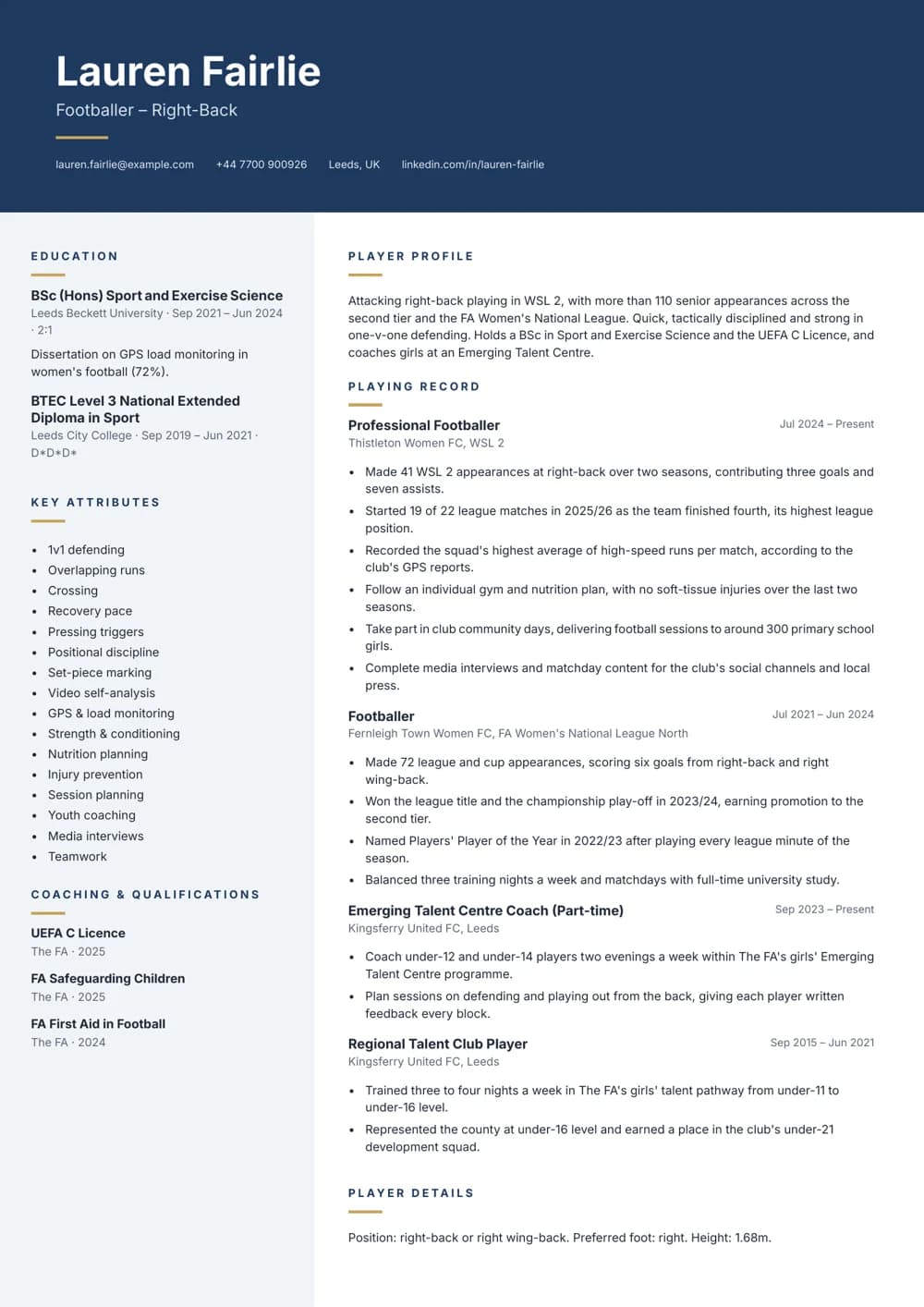
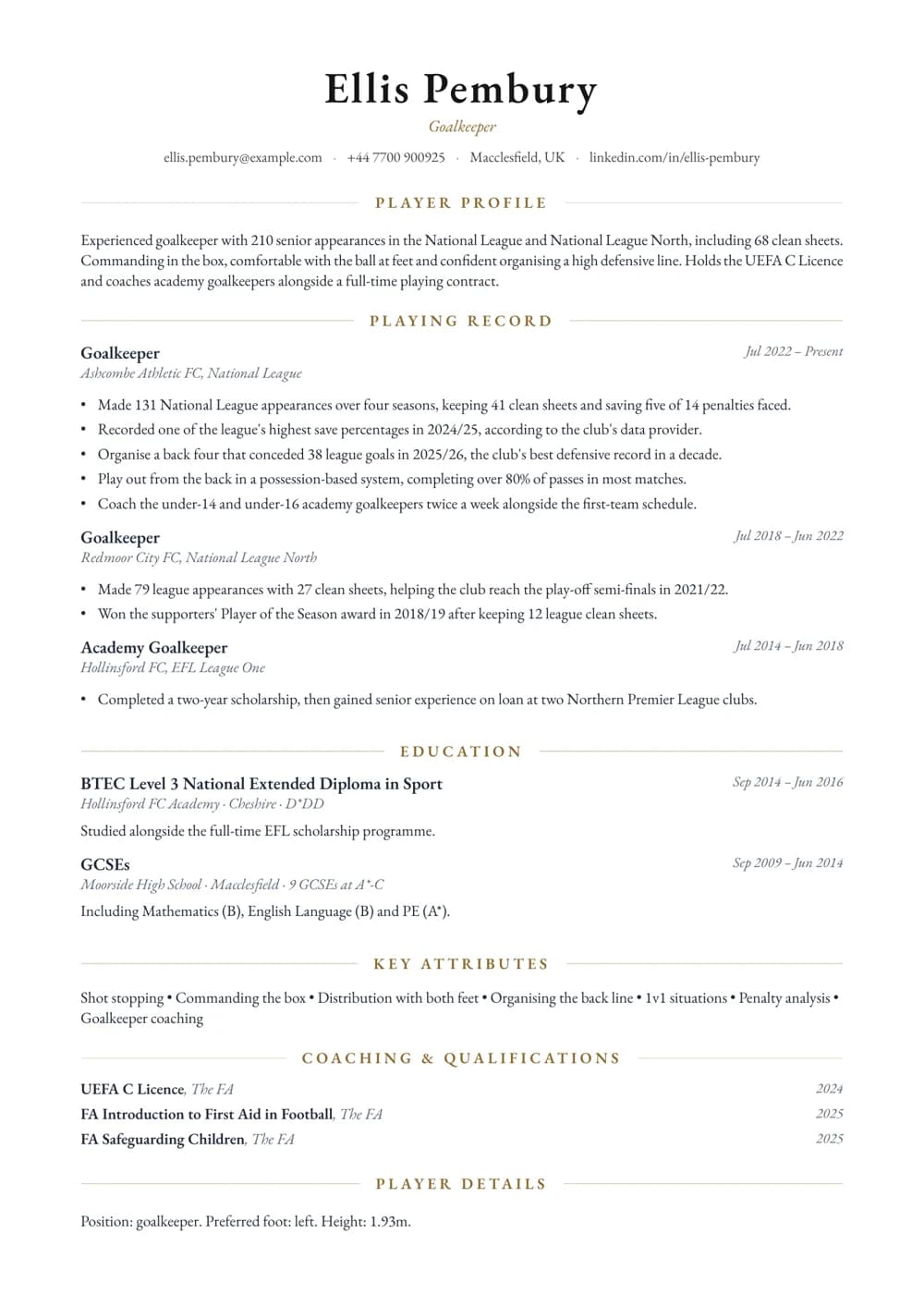
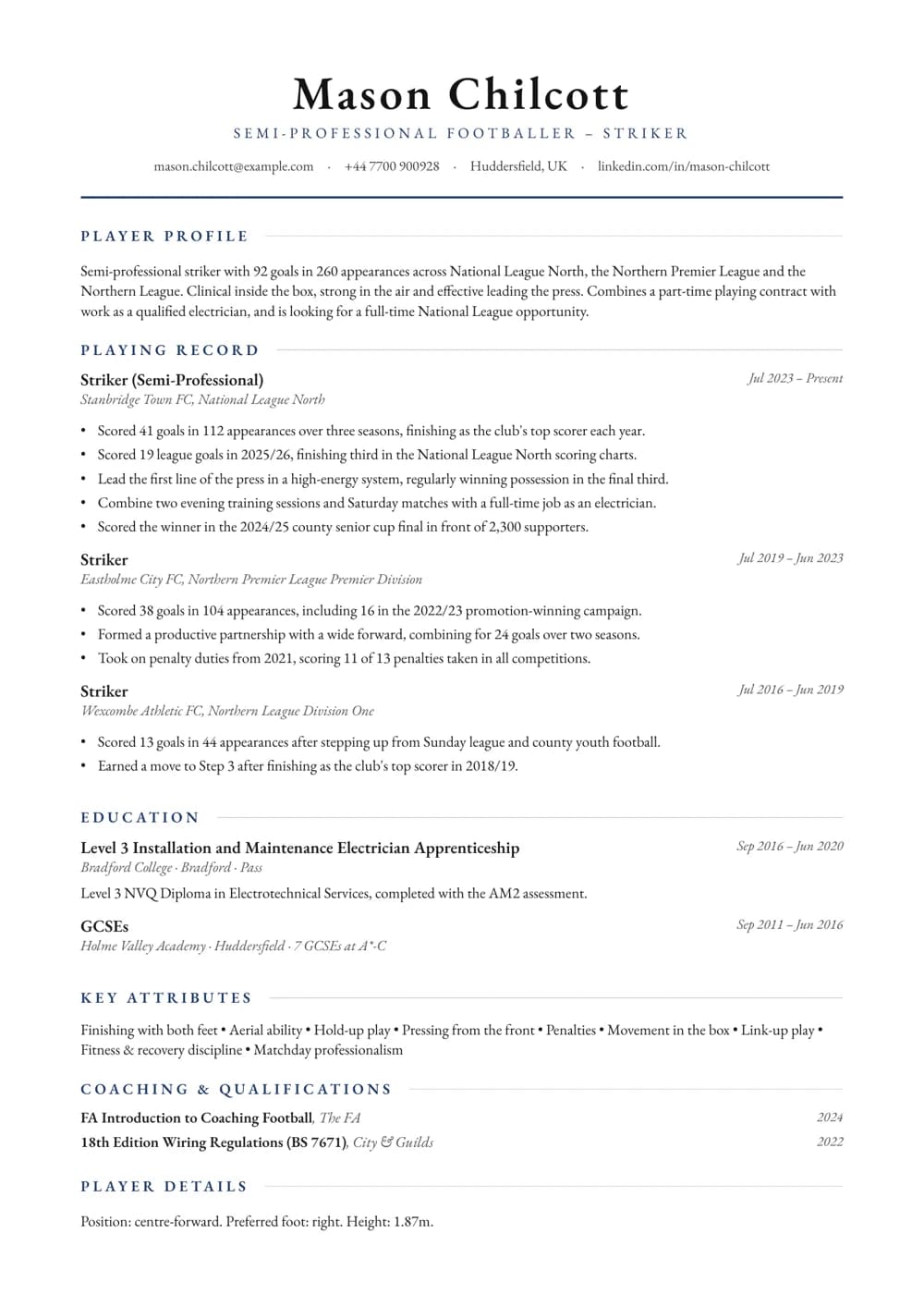
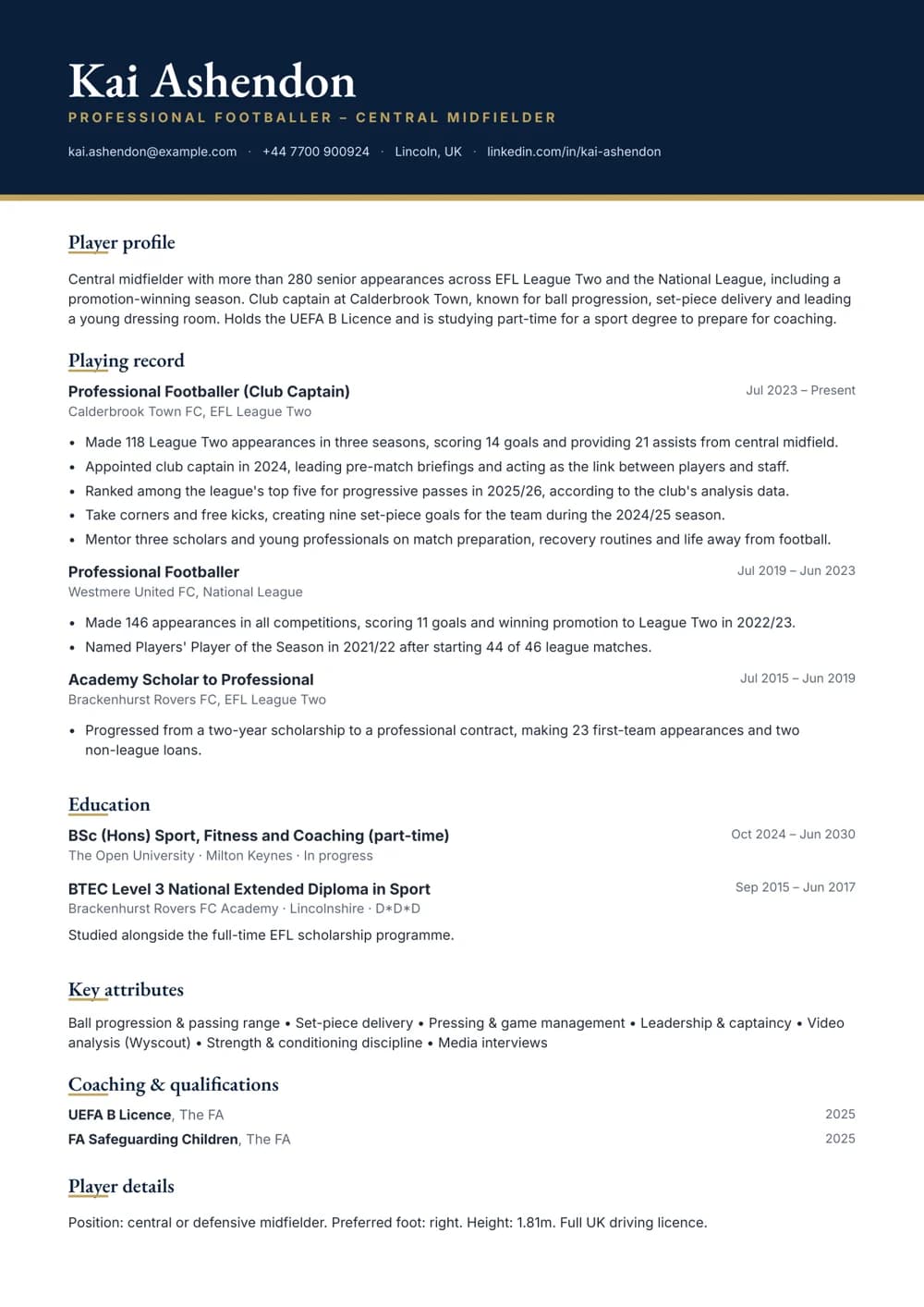
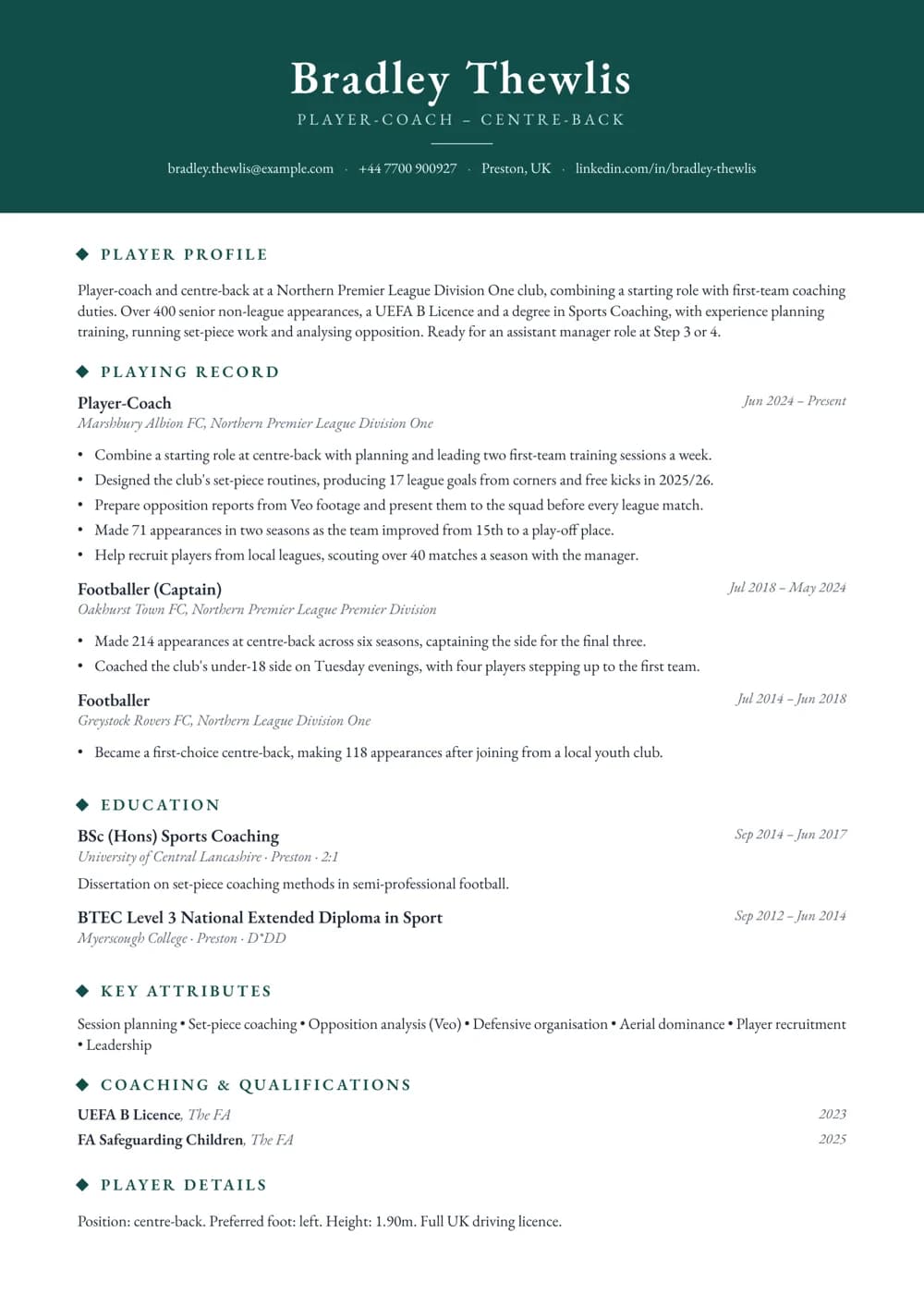
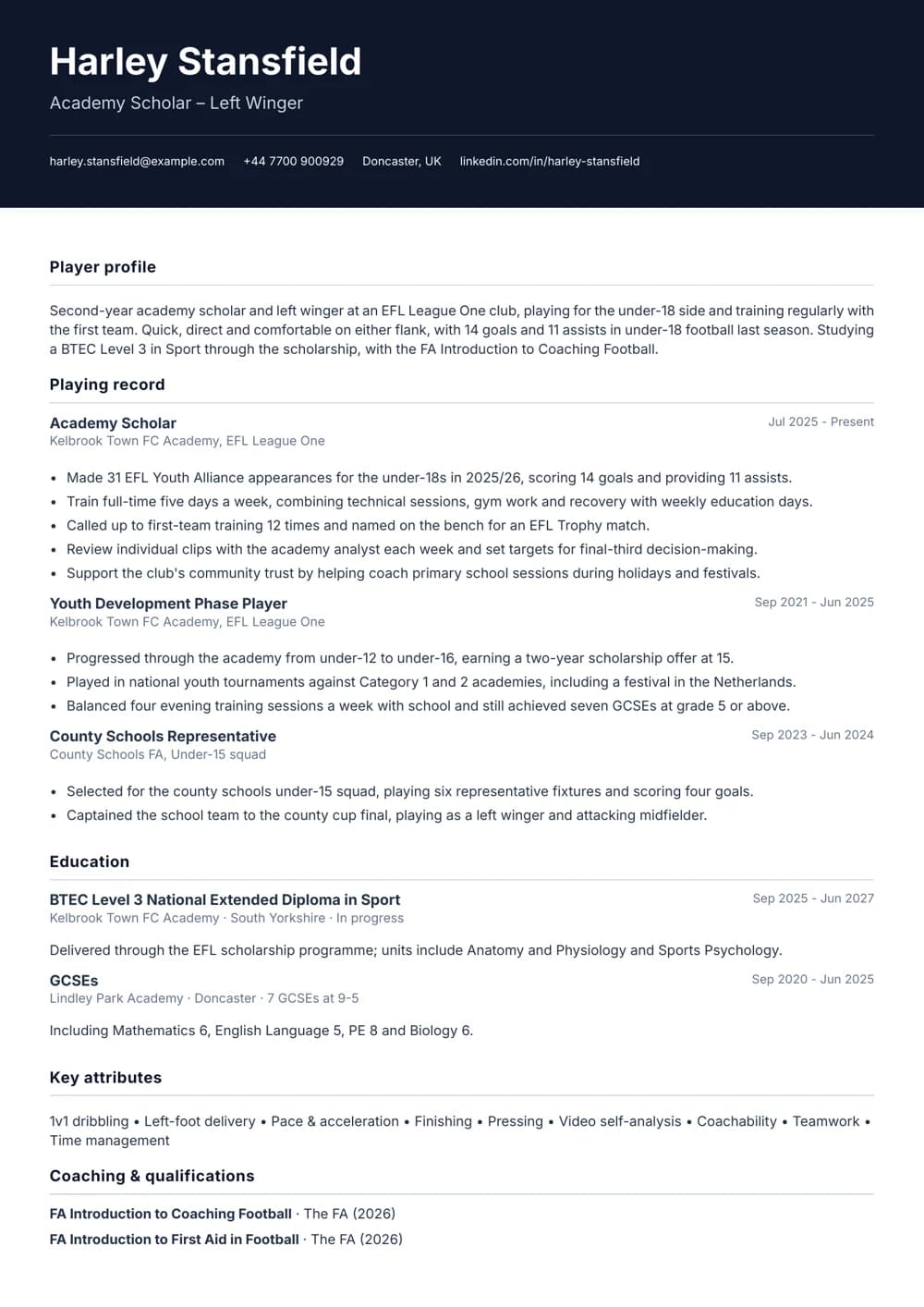
A footballer CV, often called a playing CV, is what managers, recruitment staff and agents use to decide whether to watch you play. It needs to show, at a glance, your position, level, playing record and what makes you different. The best footballer CVs are short, packed with accurate statistics, and link to match footage that backs up every claim.
This guide covers footballer CVs for UK academy scholars, semi-professional and non-league players, professionals in the EFL and National League, women's players and player-coaches. Pick one of the footballer CV templates above, then use the example, profiles and tips below to present your career clearly and professionally. The same structure works whether you are emailing a non-league manager, preparing for trials or sending your record to an agent.
A complete example you can use as a starting point. Pick a template above and the builder will pre-fill similar content for you to edit.
Tyler Brennand
Footballer – Defensive Midfielder
Stockport, UK · tyler.brennand@example.com · 07700 900933
Personal statement
Right-footed defensive midfielder, aged 23, with 150 senior appearances in the Northern Premier League and National League North. Strong in duels, disciplined positionally and comfortable receiving under pressure. Captained the under-23 side at a League Two club before moving into non-league. Looking for a full-time contract at National League level.
Experience
Footballer (Semi-Professional), Hatherford Town FC, National League North
Jul 2024 – Present
- Made 78 appearances in two seasons, starting 64 league matches as the first-choice holding midfielder.
- Won more duels than any other outfield player in the squad in 2025/26, according to the club's Wyscout data.
- Scored four goals and provided six assists, mostly from second balls and set-piece situations.
- Named the supporters' Player of the Season for 2025/26.
Footballer, Brookvale Athletic FC, Northern Premier League Premier Division
Jul 2021 – Jun 2024
- Made 72 league and cup appearances after release from a League Two academy at 18.
- Helped the team reach the play-off final in 2023/24, starting all three play-off matches.
- Completed the FA Introduction to Coaching Football and coached the club's under-12 side.
Education
BTEC Level 3 National Extended Diploma in Sport (D*D*D), EFL scholarship programme
2019 – 2021
UEFA C Licence, The FA
2025
Key skills
Ball winning and duels · Positional discipline · Passing under pressure · Leadership · Video self-analysis · Professional attitude
Player profile and key details
Open with your position (and secondary positions), preferred foot, height, age or date of birth if you choose to share it, current club and level. Football is one of the few areas where age and physical details are relevant, so recruiters expect them. Add a short summary of your playing style and what you are looking for.
Playing record
List clubs in reverse order with league or step, dates, appearances, starts, goals, assists or clean sheets. Add honours such as promotions, cup runs, player of the season awards and captaincy. Make every number accurate and checkable, because clubs will look up your record.
Video highlights and references
Include a short link to recent full matches or a highlights reel (two to five minutes) on a platform such as YouTube, Veo or Wyscout. Add one or two football references, such as a former manager or academy head, with permission to contact them.
Coaching badges and qualifications
List FA and UEFA coaching qualifications (Introduction to Coaching Football, UEFA C, UEFA B), safeguarding and first aid in football, and education such as a BTEC in Sport, a degree or a trade qualification. These matter for player-coach roles and for life after playing.
Fitness, availability and contract status
Briefly note your fitness and injury record if it is a strength, your contract status (for example "out of contract June 2027"), where you can travel to, and whether you hold a driving licence. Semi-professional players should mention work commitments and training availability.
Technical and tactical
- First touch and passing range
- Finishing or shot stopping
- Crossing and set-piece delivery
- Pressing and defensive shape
- Positional awareness
- Playing in different systems
Physical and performance
- Pace and acceleration
- Aerial ability
- Endurance and recovery
- Strength and conditioning
- Injury prevention routines
Mental and professional
- Leadership and communication
- Coachability
- Video and data analysis
- Consistency and resilience
- Media and community work
- Balancing football with work or study
Academy scholar or youth player
Left-footed winger, aged 17, in the second year of an EFL scholarship. Quick, direct and comfortable on either flank, with 14 goals and 11 assists for the under-18s last season and regular first-team training. Studying a BTEC Level 3 in Sport and looking for a first professional contract or a development opportunity.
Semi-professional player
Centre-back with 180 appearances at Steps 3 and 4 of non-league football, strong in the air and an organiser of the back line. Captained my current club to a play-off finish and holds the UEFA C Licence. Available for two evenings and Saturdays alongside full-time work, looking to step up to National League North or South.
Experienced professional or player-coach
Central midfielder with more than 300 EFL and National League appearances, two promotions and three seasons as club captain. Holds the UEFA B Licence and has coached the under-18 side alongside playing. Seeking a player-coach role where experience, leadership and set-piece expertise can help a squad compete for promotion.
- Put your position and level at the very top. A recruiter should see your position, foot, age and current level within seconds. Use your title line for this, for example "Centre-back, left-footed, National League North".
- Let the numbers talk. Appearances, starts, minutes, goals, assists and clean sheets carry more weight than adjectives. Use the most recent and most relevant seasons, and be accurate.
- Always include footage. No club signs a player from a CV alone. A recent highlights reel plus a full match link lets recruiters see your decision-making, not just your best moments.
- Keep it short. One page is ideal for most players; two pages suits long professional careers. Leave out school details if you have a long playing record.
- Keep a second CV for work outside football. Many players work or study alongside football or move on from playing. A separate CV that translates teamwork, discipline and coaching into workplace skills makes that move easier.
What should a footballer CV include?+
Your name and contact details, position, preferred foot, height, age, current club and level, followed by a short playing profile, a playing record with appearances and goals or clean sheets, honours, coaching badges, education and a link to match footage. Add references from coaches or managers who have agreed to be contacted.
How long should a footballer CV be?+
One page is ideal for academy, youth and most semi-professional players, because managers and recruiters want the key facts quickly. Professionals with long careers across several clubs can use two pages. Keep statistics in a clear, consistent format so they can be scanned in seconds.
Should a footballer CV have a photo?+
Standard UK CVs do not include photos, but a playing CV sent to clubs or agents often includes a clear, recent head-and-shoulders photo or a match action shot so recruiters can recognise you on video. It is optional. Leave the photo off any CV you use for jobs outside football.
How do I get a trial with a football club?+
Send a short email with your CV and video link to the manager, head of recruitment or academy staff, explaining your position, level and availability. Non-league clubs often run pre-season trials in June and July. Ask your current manager or coach for a recommendation, and be honest about your current level.
Should I include coaching badges on a playing CV?+
Yes. Coaching qualifications such as the FA Introduction to Coaching Football, UEFA C or UEFA B Licence show commitment and understanding of the game, and they are essential if you want a player-coach role. Include safeguarding and first aid in football certificates too, as clubs need these for anyone working with young players.
How do I write a CV after leaving professional football?+
Lead with a profile that explains your transition and the role you want next, then translate your football career into workplace evidence: leadership, discipline, performance under pressure, teamwork and community work. Add any qualifications gained during your career, such as a degree, trade qualification or coaching badges, and keep match statistics brief.
Browse all our CV templates for every role and industry.
View All Templates