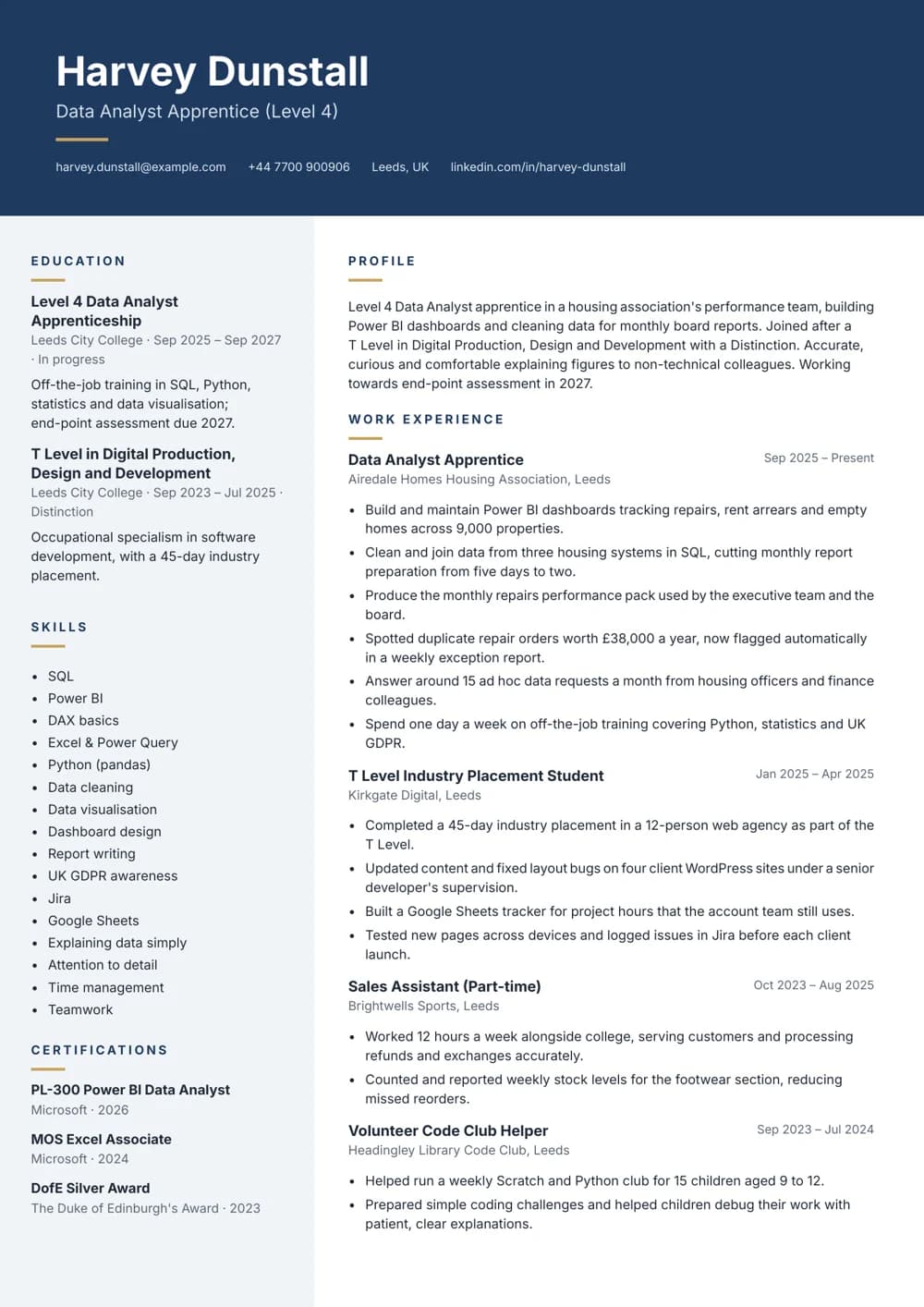
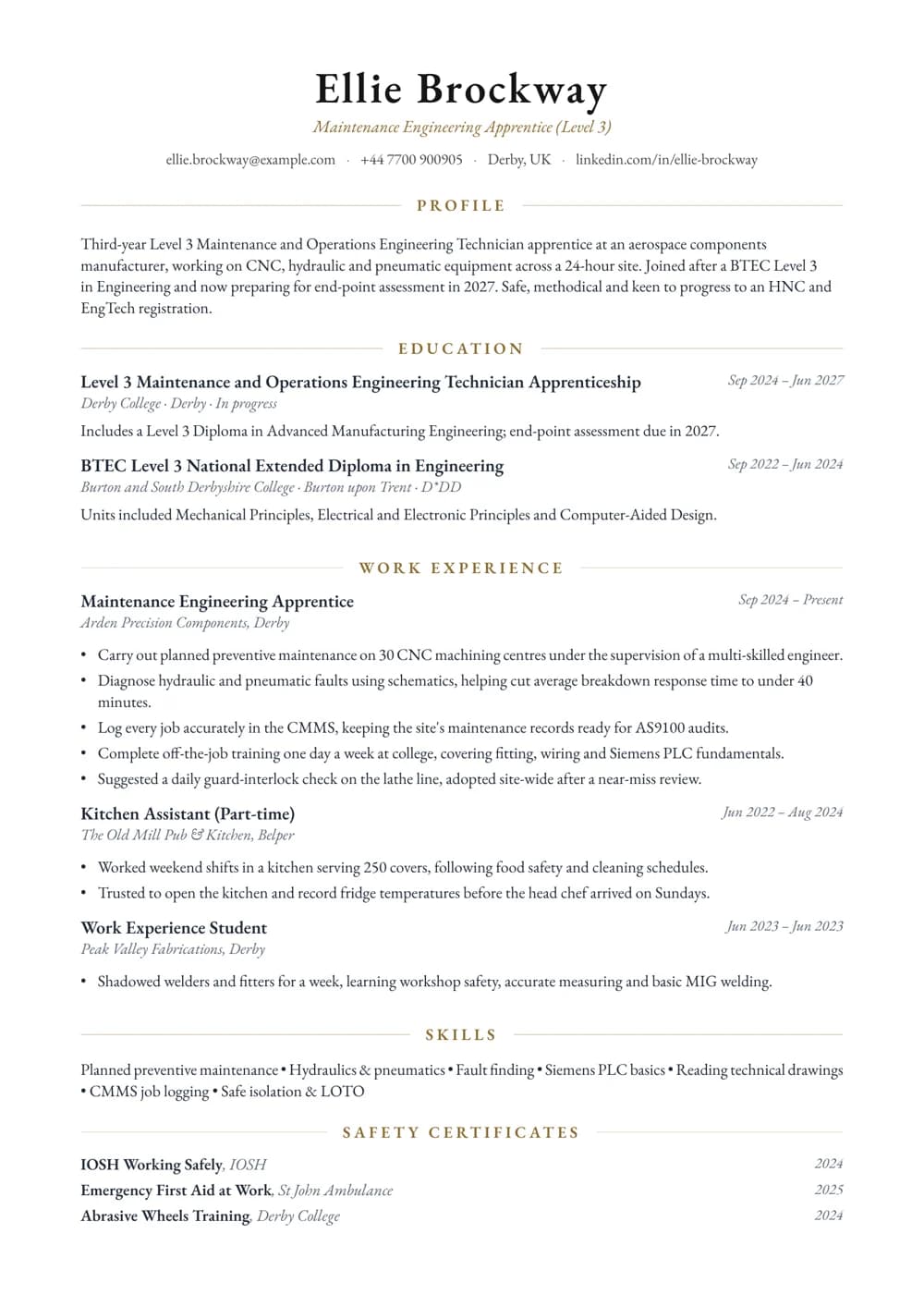
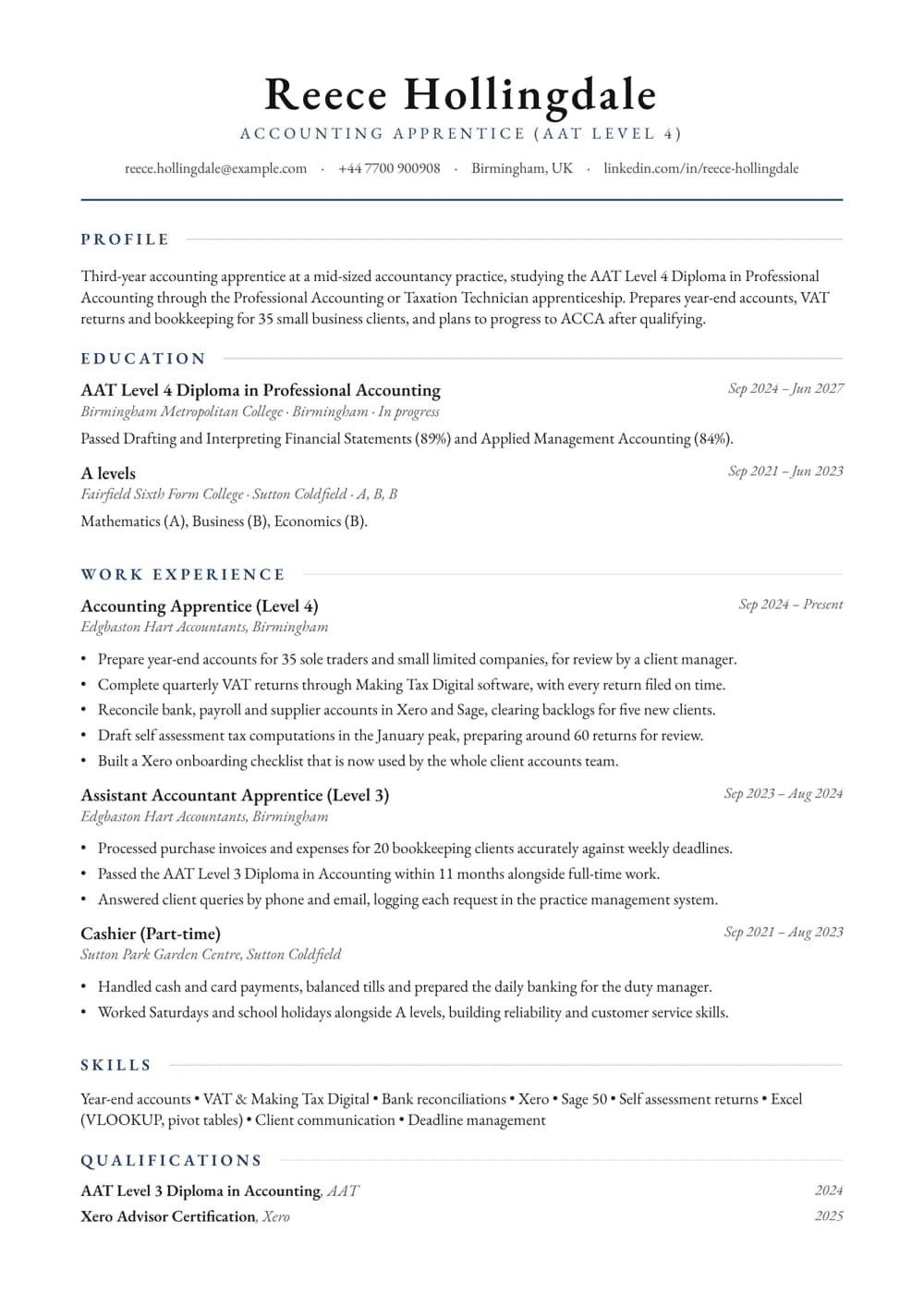
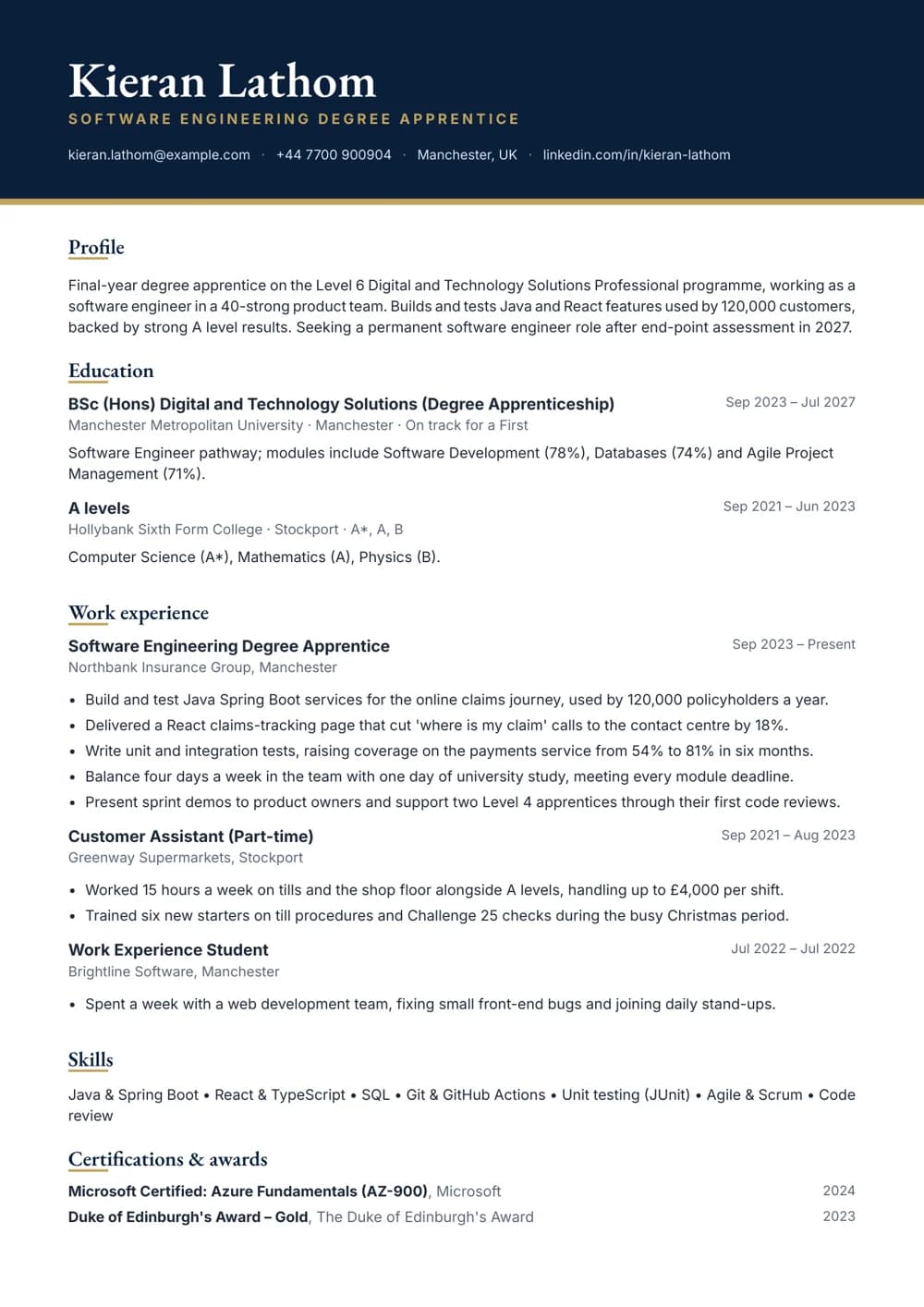
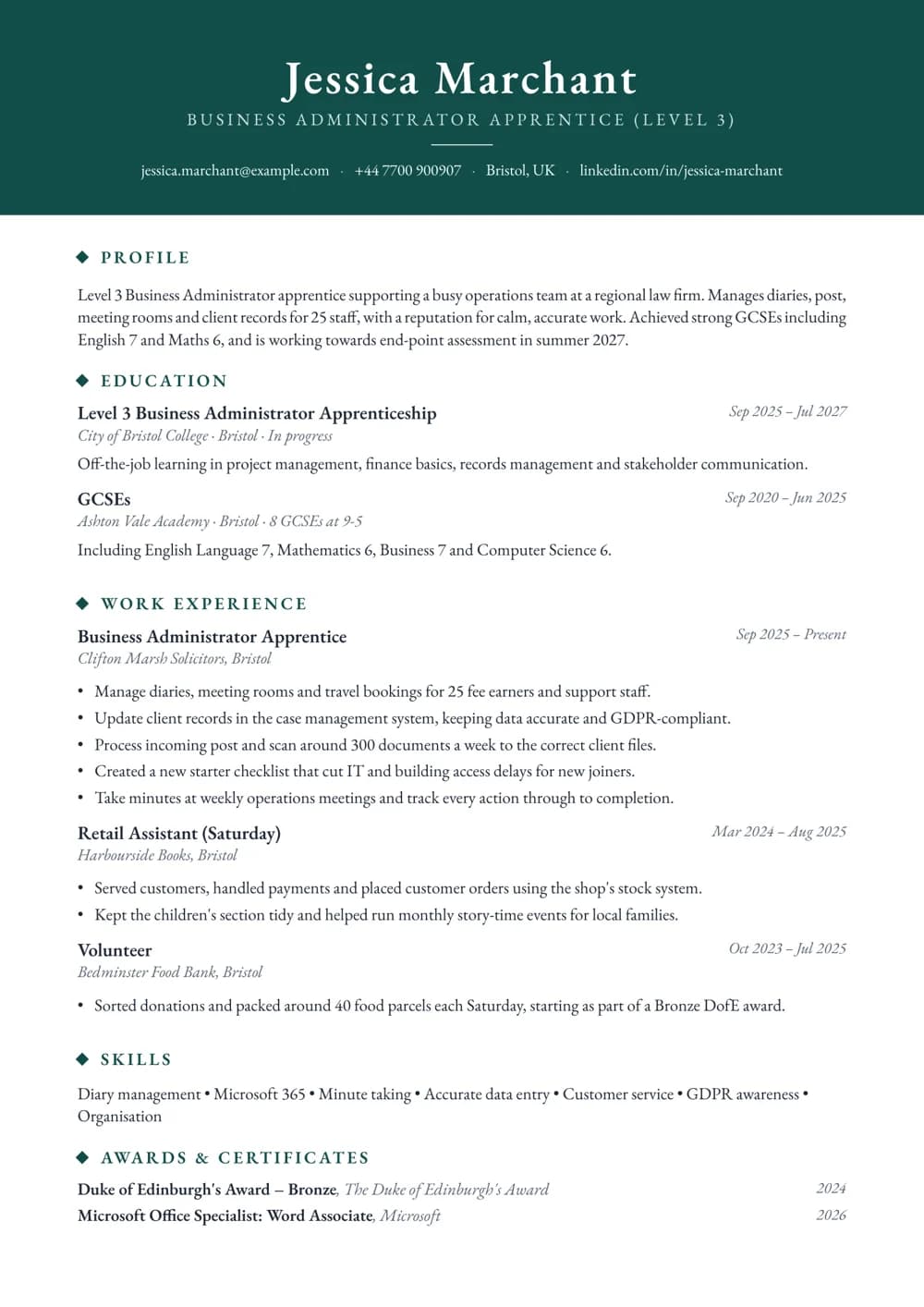
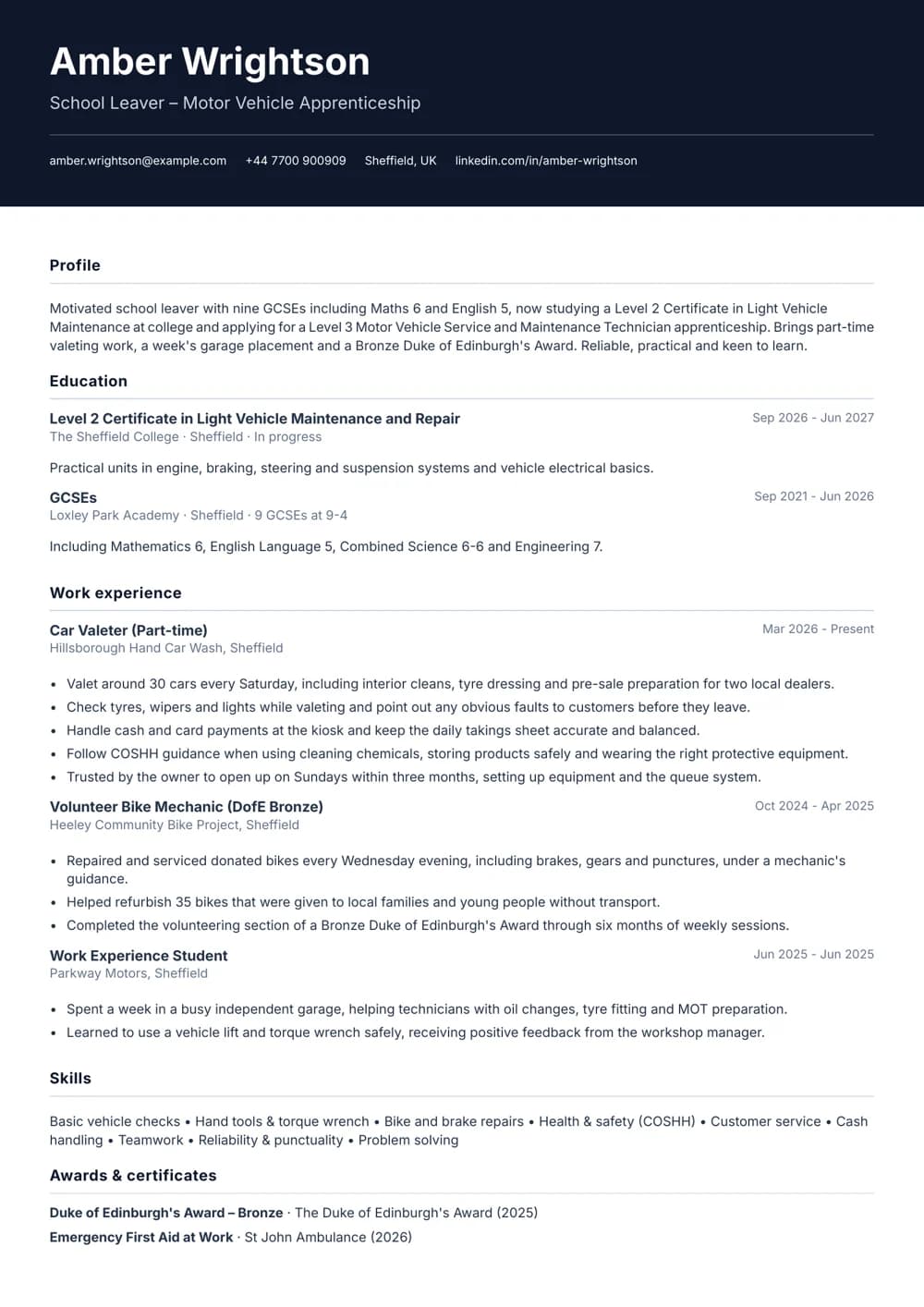
An apprenticeship CV has a different job from a normal CV. Most applicants have little or no full-time work history, so employers look for evidence that you are reliable, can learn quickly and will cope with work plus off-the-job study. A good apprenticeship CV leads with your education, then backs it up with part-time jobs, volunteering, work experience and projects that show those qualities.
This guide covers UK apprenticeships at every level, from Level 2 and Level 3 roles for school leavers to Level 4 higher apprenticeships and Level 6 degree apprenticeships. Pick one of the apprenticeship CV templates above, then use the example, personal statements and tips below to write content that gets you shortlisted. Every template is ATS-friendly, so it reads correctly in the online systems many large employers and training providers use.
A complete example you can use as a starting point. Pick a template above and the builder will pre-fill similar content for you to edit.
Jacob Whitehurst
School Leaver – Level 3 Electrical Apprenticeship
Stoke-on-Trent, UK · jacob.whitehurst@example.com · 07700 900931
Personal statement
Hard-working school leaver with eight GCSEs including Maths 6, English Language 5 and Physics 6, applying for a Level 3 Installation and Maintenance Electrician apprenticeship. A year of part-time work in a builders' merchant and a week shadowing a domestic electrician have given practical experience of tools, materials and site safety. Punctual, careful and keen to qualify as an electrician.
Experience
Yard Assistant (Part-time), Trentside Builders Merchants, Stoke-on-Trent
Sep 2025 – Present
- Work Saturdays loading customer orders, checking deliveries against paperwork and keeping the yard safe and tidy.
- Learned to identify cable sizes, conduit and fixings so trade customers are served quickly and correctly.
- Trusted to cover the trade counter at lunchtimes after three months, handling cash and account sales.
Work Experience Student, Hartshill Electrical Services, Stoke-on-Trent
Jun 2025
- Shadowed a qualified electrician for a week on rewires and consumer unit changes in domestic properties.
- Helped with first-fix cabling, labelling circuits and clearing up, always following the safe isolation procedure.
- Received a written reference praising timekeeping and willingness to take on any task.
Education
GCSEs: 8 at grades 9-4, including Maths 6, English Language 5, Physics 6, Hanley Park Academy
2021 – 2026
Duke of Edinburgh's Award – Bronze, Hanley Park Academy
2025
Key skills
Basic hand and power tools · Health and safety awareness · Maths and measuring · Customer service · Teamwork · Reliability and punctuality
Personal statement aimed at the apprenticeship
Name the apprenticeship you are applying for, including the level and occupation (for example "Level 3 Engineering Technician" or "Level 4 Data Analyst"). Say what you are studying or have achieved, one or two things that prove you are reliable, and why you want this career. Keep it to four or five lines.
Education and grades first
For most apprentices, education is the strongest section, so put it straight after your personal statement. List GCSEs with grades (9-1, or letters for older qualifications), and any A levels, T Levels, BTECs or college courses with grades or predicted grades. Make English and maths easy to find, as many employers check them first.
Work experience, part-time jobs and volunteering
Saturday jobs, school work experience, T Level industry placements and volunteering all count. Describe what you did and add numbers where you can: hours a week, customers served, money handled or people trained. Employers want proof you turn up on time, follow instructions and get on with a team.
Achievements, awards and projects
Duke of Edinburgh's Awards, sports teams, cadets, Young Enterprise, coding projects, an EPQ or anything you have built, fixed or organised can set you apart. Choose the ones most relevant to the apprenticeship and say briefly what you achieved.
Skills and practical certificates
List practical and job-related skills rather than generic words: tools, software, safety knowledge, languages and driving licence status. Short certificates such as first aid, food hygiene, IOSH Working Safely or a CSCS card are worth including for trades and engineering roles.
Practical and technical skills
- Hand and power tools
- Reading drawings and instructions
- Microsoft Office or Google Workspace
- Basic coding or data skills
- Measuring and maths
- Health and safety awareness
Workplace skills
- Reliability and punctuality
- Following instructions
- Customer service
- Teamwork
- Time management
- Taking feedback
Learning and study skills
- Balancing work and study
- Note-taking and revision
- Research
- Problem solving
- Written communication
School leaver (Level 2/3)
Practical school leaver with seven GCSEs including Maths 5 and English 5, applying for a Level 3 Plumbing and Domestic Heating Technician apprenticeship. Part-time work in a cafe and a week's work experience with a heating engineer have built reliability, customer service and confidence with tools. Keen to learn the trade properly and work towards Gas Safe registration.
A level or T Level leaver (Level 4)
A level student predicted A, B, B in Computer Science, Maths and Business, applying for Level 4 software developer and data analyst apprenticeships. Builds small Python and web projects in spare time, works 10 hours a week in retail and helps run a school coding club. Looking for an employer where I can earn, learn and progress to a degree apprenticeship.
Degree apprentice or career changer
Second-year degree apprentice on the Chartered Manager programme, leading a team of six in a logistics operation while studying for a BSc in Business Management. Delivered a rota change that cut overtime costs by 12% and runs weekly performance reviews. Seeking a degree apprenticeship role with greater responsibility for people and operations.
- Match the apprenticeship standard. Every apprenticeship is built on a published standard that lists the knowledge, skills and behaviours needed. Read the one for your role and use the same words where they genuinely describe your experience.
- Lead with education if experience is thin. If you are leaving school or college, put education before experience. Employers expect it and it puts your strongest evidence at the top.
- Turn everyday jobs into evidence. A paper round, Saturday job or volunteering shift shows reliability. Write what you did and how well, for example "trusted to open up" or "trained three new starters".
- Keep it to one page. Most school and college leavers should fit everything onto one clear page. Degree apprentices and career changers can use two if the content is relevant.
- Use a sensible email address and check every word. Set up a simple firstname.lastname style email, ask a teacher or parent to proofread, and make sure your phone voicemail is ready for an employer's call.
How long should an apprenticeship CV be?+
One A4 page is right for most school and college leavers applying for Level 2, 3 or 4 apprenticeships. If you are applying for a degree apprenticeship with a lot of relevant experience, or changing career, two pages is acceptable. Recruiters spend little time on each CV, so a focused page usually works better than a longer one.
How do I write an apprenticeship CV with no work experience?+
Lead with your education and grades, then add school work experience, volunteering, clubs, sports, Duke of Edinburgh's Award, caring responsibilities and projects. Each of these shows qualities employers want, such as reliability and teamwork. Explain what you did and what you achieved, and use your personal statement to show why you want that career.
Which GCSE grades should I put on my CV?+
List your GCSEs with grades, putting English and maths first because many apprenticeships ask for grade 4 or above in both. Use the 9-1 grades shown on your certificate, or letter grades for older qualifications. If you are still waiting for results, write "predicted" next to each grade and update your CV when results arrive.
Should I include a photo on an apprenticeship CV?+
No. UK employers do not expect a photo, and leaving it off helps avoid bias. You also do not need your date of birth, nationality or full home address. Your name, phone number, email address and town or city are enough.
Do I need a CV if I apply through Find an apprenticeship?+
The government's Find an apprenticeship service and many large employers use online application forms rather than CVs. Writing a CV first still helps, because you can copy accurate dates, grades and examples into the form. Smaller employers, training providers and colleges often ask for a CV and cover letter instead.
What is different about a degree apprenticeship CV?+
Degree apprenticeship employers expect stronger academic results, usually A levels, a T Level or a Level 3 BTEC, plus evidence you can handle university study alongside a full-time job. Include predicted or achieved grades, an EPQ if you have one, relevant projects and any work or leadership experience, and show a clear interest in the profession.
Browse all our CV templates for every role and industry.
View All Templates