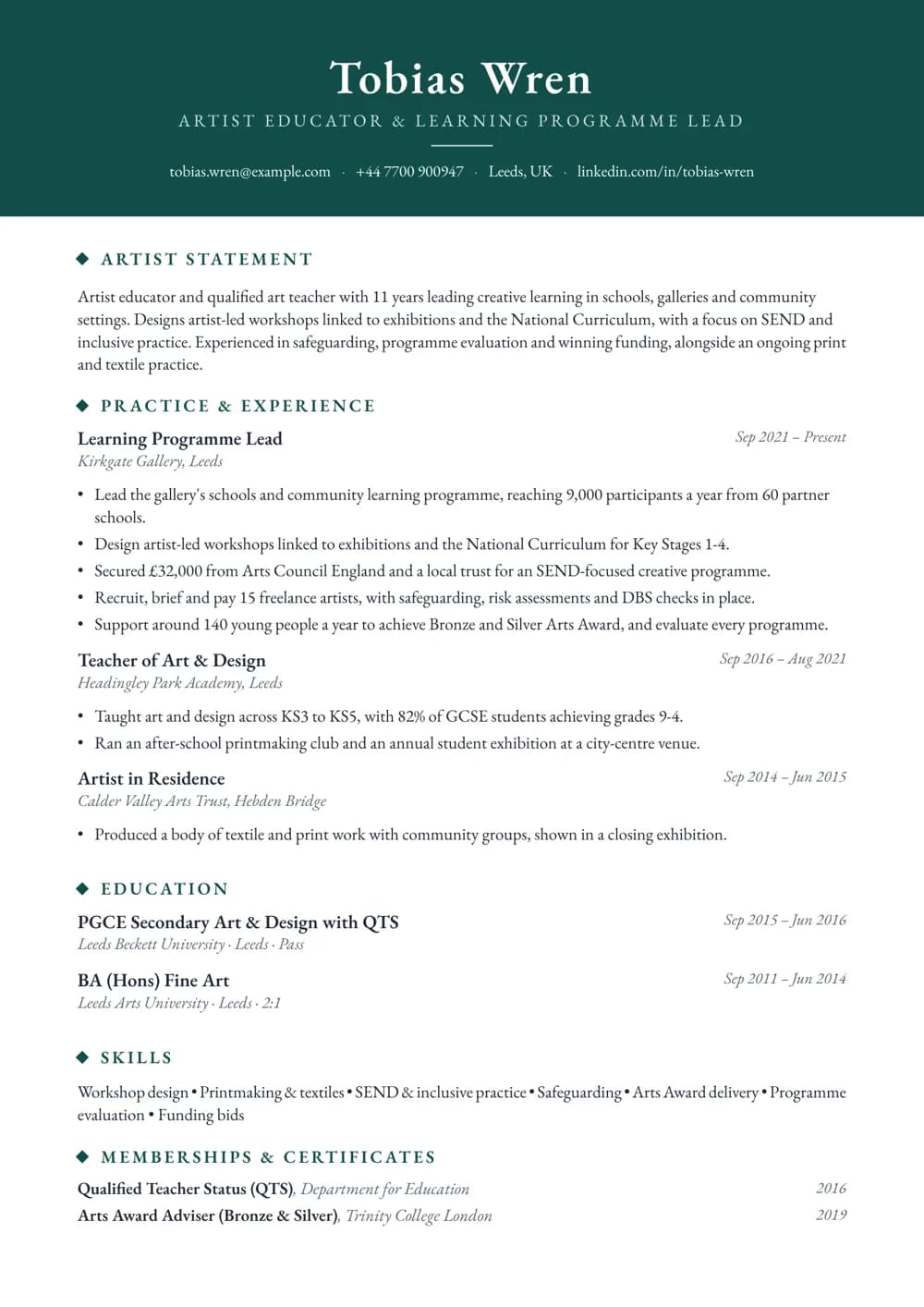
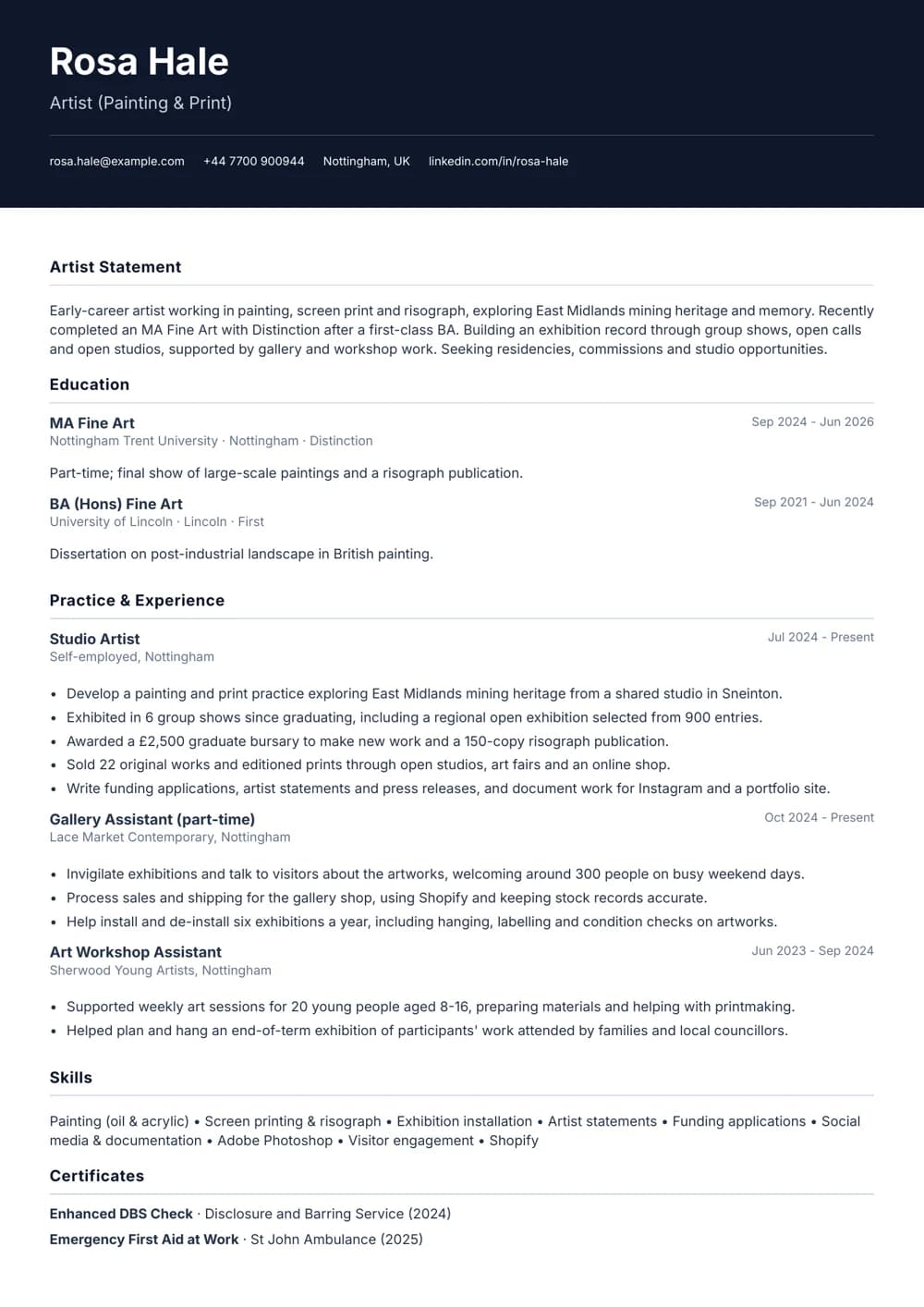
An artist CV is a record of your practice: where you have shown work, who has supported it and what you have made happen. Galleries, residency panels, funders and employers in the UK read it alongside your portfolio, so a strong artist CV is clear, factual and easy to check, listing exhibitions, commissions, residencies, awards and teaching in a consistent format rather than describing your work in long paragraphs.
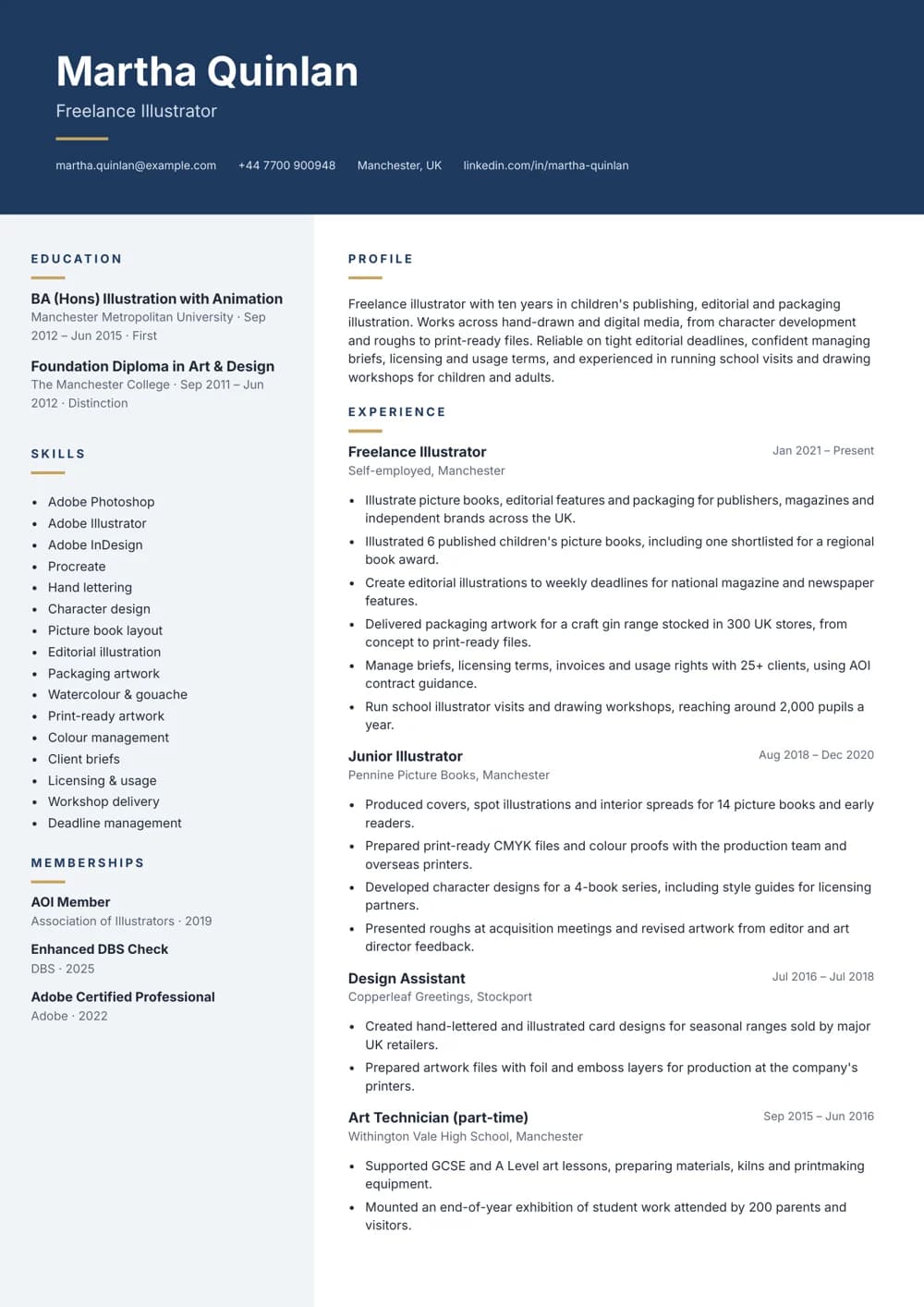
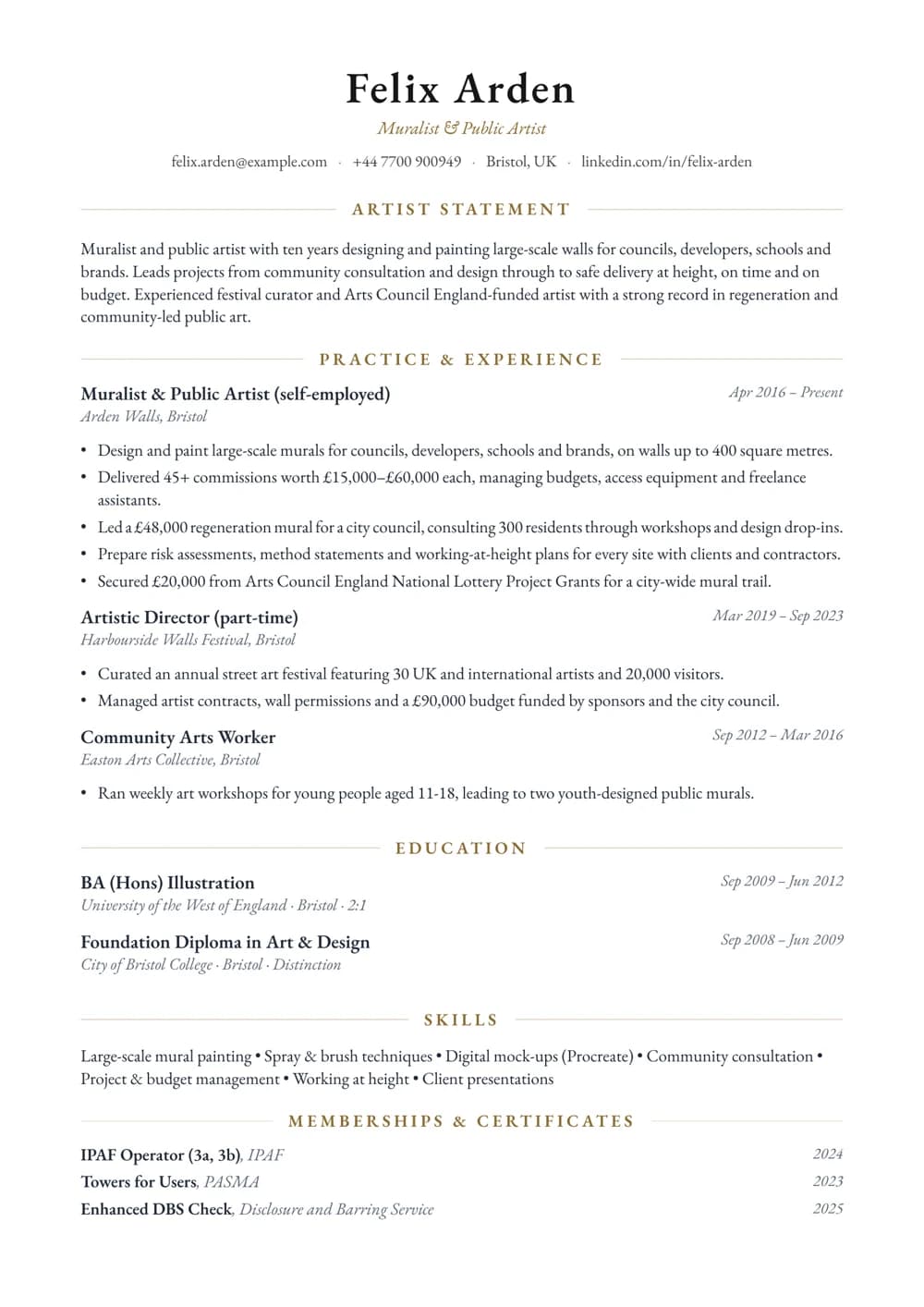
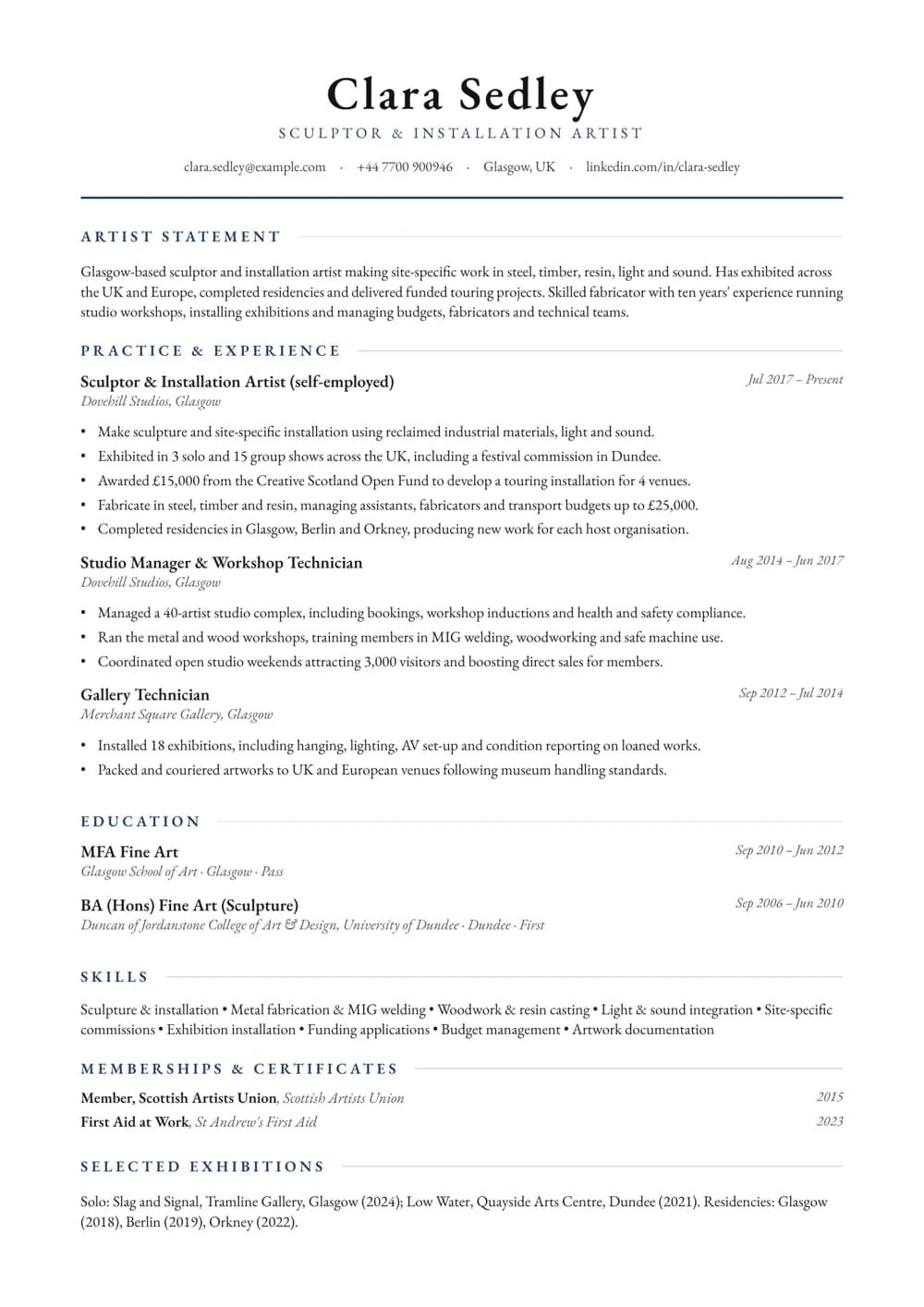
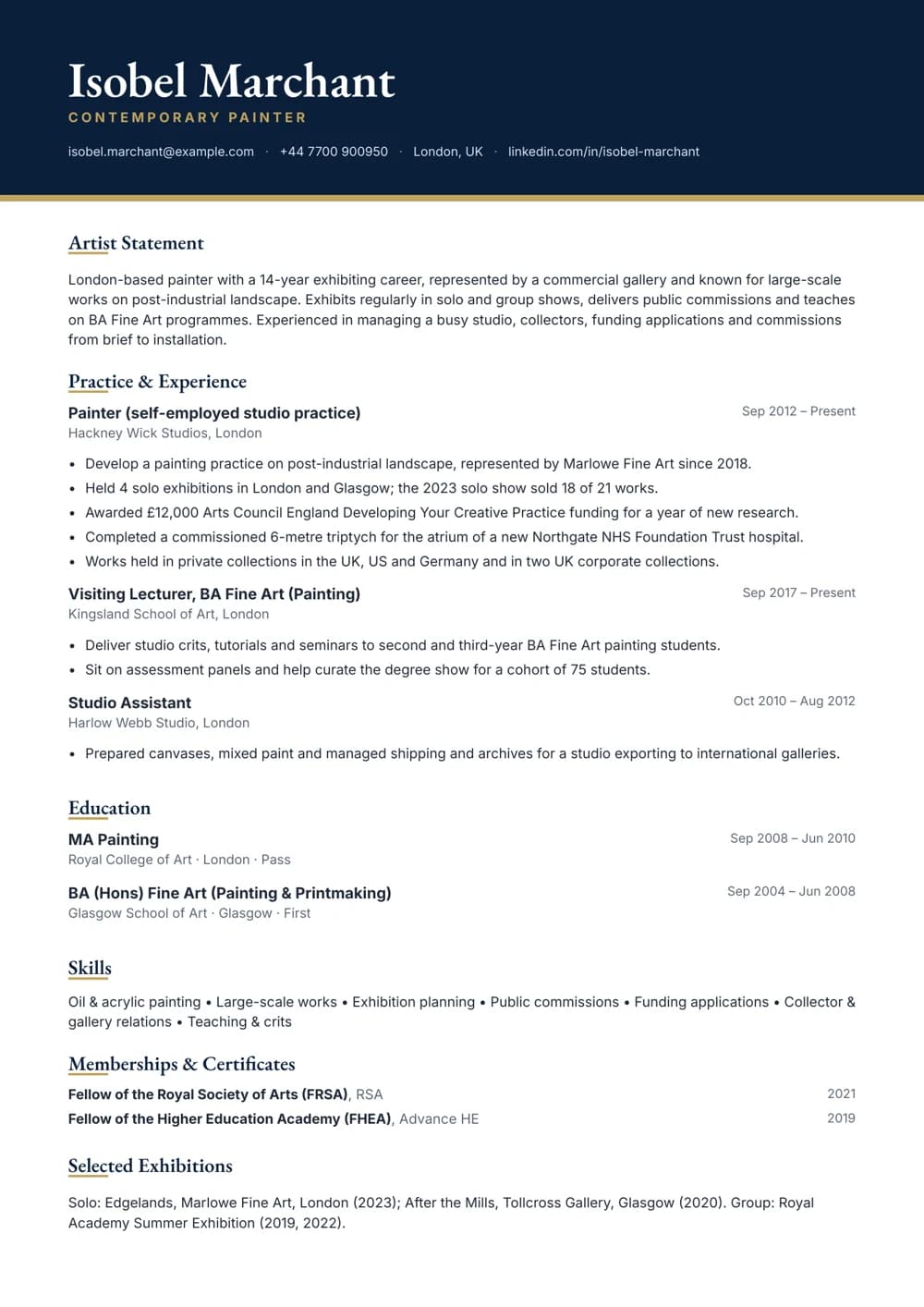
This guide covers fine artists, painters, sculptors, illustrators, muralists, artist educators and early-career artists fresh from a BA or MA. Use one of the artist CV templates above for a clean, ATS-friendly layout that also works for job applications, then follow the UK example and tips below to decide what to include, what to leave out and how to present a practice that is still growing.
A complete example you can use as a starting point. Pick a template above and the builder will pre-fill similar content for you to edit.
Lucy Ambrose
Artist – Painting & Printmaking
Sheffield, UK · lucy.ambrose@example.com · 07700 900952
Personal statement
Sheffield-based painter and printmaker whose work explores urban edgelands, allotments and informal green space. Has shown in two solo and 12 group exhibitions across the North of England since 2019, completed two funded residencies and delivered community commissions. Combines a studio practice with gallery learning work and sessional teaching on a BA Fine Art course.
Experience
Artist (studio practice), Kelham Island Studios, Sheffield
Sep 2019 – Present
- Make paintings and editioned screen prints, selling through open studios, two commercial galleries and an online shop.
- Awarded £8,500 from Arts Council England to research and produce a new body of work and a touring exhibition.
- Completed a public commission of six large-scale prints for a community health centre, working with patient groups.
Sessional Lecturer, BA Fine Art, Don Valley School of Art, Sheffield
Sep 2022 – Present
- Lead printmaking inductions and tutorials for 60 first-year students each autumn term.
- Give crits and feedback on studio work and contribute to end-of-year assessment.
- Organise visiting artist talks and a student trip to a regional contemporary art biennial.
Education
MA Fine Art, Distinction, Sheffield Hallam University
2017 – 2019
BA (Hons) Fine Art, First, Leeds Arts University
2013 – 2016
Foundation Diploma in Art & Design, Distinction, Leeds College of Art
2012 – 2013
Key skills
Oil painting · Screen printing and etching · Exhibition installation · Funding applications · Workshop delivery · Artwork documentation and photography
Exhibitions
Split into solo and group exhibitions, listed newest first. Give the year, exhibition title, venue and city, e.g. "2024 – Low Water, Quayside Arts Centre, Dundee (solo)". Include open submission shows, artist-led spaces and online exhibitions if they were selected, and use "Selected exhibitions" once the list gets long.
Residencies, awards and funding
List residencies, prizes, shortlists, bursaries and grants with the year and organisation. UK funders to name include Arts Council England, Creative Scotland, Arts Council of Wales and Arts Council of Northern Ireland. You can state grant amounts if you are comfortable doing so, as they show funders have trusted you before.
Commissions and collections
Public art commissions, murals, private commissions and works in public, corporate or private collections all belong on an artist CV. Name the commissioner and site where you can, and note the scale or budget for public projects.
Teaching, workshops and employment
Most artists combine their practice with other work. Include lecturing, school and gallery education, community workshops, technician and studio roles, and gallery or art handling jobs. These matter for employers and show the skills residency and funding panels look for.
Education, publications and memberships
Add your BA and MA in Fine Art or a related subject, foundation diploma, and any PGCE or teaching qualification. Include press coverage, catalogues and publications, plus memberships such as a-n The Artists Information Company, Artists' Union England, the Scottish Artists Union or the Association of Illustrators.
Making and technical
- Painting (oil, acrylic, watercolour)
- Printmaking (screen print, etching, risograph)
- Sculpture and fabrication
- Digital illustration (Procreate, Photoshop)
- Large-scale and mural painting
- Installation, lighting and AV
Professional practice
- Funding and residency applications
- Writing artist statements
- Exhibition planning and curating
- Pricing, sales and invoicing
- Contracts, licensing and copyright
- Artwork documentation and social media
Teaching and engagement
- Workshop design and delivery
- Community engagement and consultation
- Safeguarding and DBS clearance
- SEND and inclusive practice
- Crits and tutorials
- Public speaking and artist talks
Graduate / early-career artist
Recent Fine Art graduate (BA Hons, First) working in painting and risograph print, exploring memory and place in former mining communities. Exhibited in four group shows since graduating and selected for a regional open exhibition. Experienced in gallery invigilation and youth workshops, and seeking a residency, studio award or gallery assistant role to develop my practice.
Illustrator / artist educator
Freelance illustrator with seven years in children's publishing and editorial work, with five picture books published. Runs school visits and drawing workshops for up to 2,000 pupils a year and holds an enhanced DBS check. Comfortable managing briefs, licensing and deadlines across several clients at once.
Established artist
Painter with a 15-year exhibiting career, represented by a London gallery, with six solo shows and work in UK and international private collections. Has delivered public commissions for health and education settings and received Arts Council England funding twice. Teaches as a visiting lecturer on BA Fine Art programmes and mentors early-career artists.
- Keep two versions. Use an exhibition-led artist CV for galleries, residencies and funders, and a skills and experience-led CV for jobs in teaching, galleries or the creative industries.
- Be consistent and checkable. Use the same format for every entry: year, title, venue, city. Panels often check details, so make sure titles, dates and venue names are accurate.
- Link to your portfolio. Add a website or online portfolio link in your contact details. Your CV gives the facts; the portfolio shows the work.
- Do not pad the list. A short list of strong, relevant shows reads better than every exhibition you have ever been in. Switch to "Selected exhibitions" once you have more than eight or ten.
- Save the artist statement for its own document. Keep the CV profile to three or four lines. Most open calls and funders ask for a separate artist statement, so put your longer description of the work there.
How long should an artist CV be?+
One to two A4 pages is usual for an artist CV in the UK. Early-career artists can often fit everything on one page. Established artists with long exhibition histories should use "Selected exhibitions" and keep the CV to two pages, adding a full list only if a gallery or funder specifically asks for it.
What is the difference between an artist CV and a normal CV?+
An artist CV is organised around your practice: exhibitions, residencies, commissions, awards, collections and publications, usually listed by year with little description. A standard CV focuses on jobs and skills with bullet points. Many artists keep both and use the standard version for teaching, gallery, technician and creative industry jobs.
How do I write an artist CV with no exhibitions?+
Start with education, including your degree show and any student exhibitions, then add open studios, pop-up or artist-led shows, online exhibitions, competitions, commissions for friends or local businesses, and workshops you have helped run. Relevant jobs such as gallery assistant or art technician also count. Every artist starts somewhere, so keep it honest and well presented.
Should I include a photo or images on my artist CV?+
Do not include a photo of yourself, as this is not expected on UK CVs. Images of your work belong in your portfolio, which you can link from your contact details. Some open calls ask for images to be submitted separately, and adding images to the CV can make it harder to read and less ATS-friendly.
Should I put grants and funding amounts on my CV?+
Listing grants, bursaries and awards is a good idea, as it shows that funders and panels have backed your work. Name the funder and year, for example "Arts Council England, National Lottery Project Grant, 2024". Including the amount is optional; many artists include it for larger grants and leave it out for small ones.
Do I need a degree to be an artist in the UK?+
No. Many successful artists are self-taught or came through foundation courses, community studios or other careers. A BA or MA in Fine Art can help with networks, teaching jobs and some residencies, but galleries and most funders judge your work and track record. If you do not have a degree, lead with exhibitions and practice instead.
Browse all our CV templates for every role and industry.
View All Templates