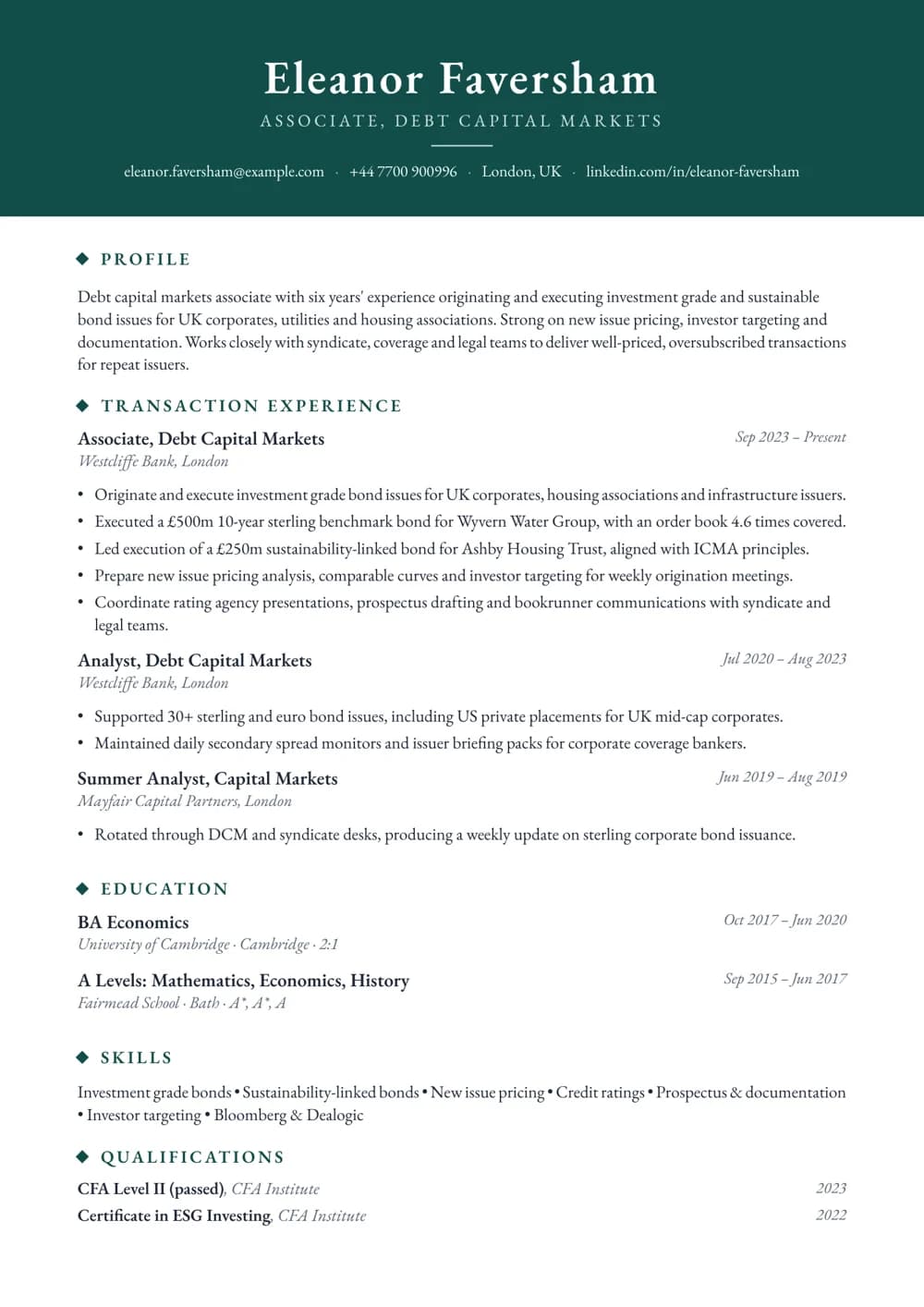
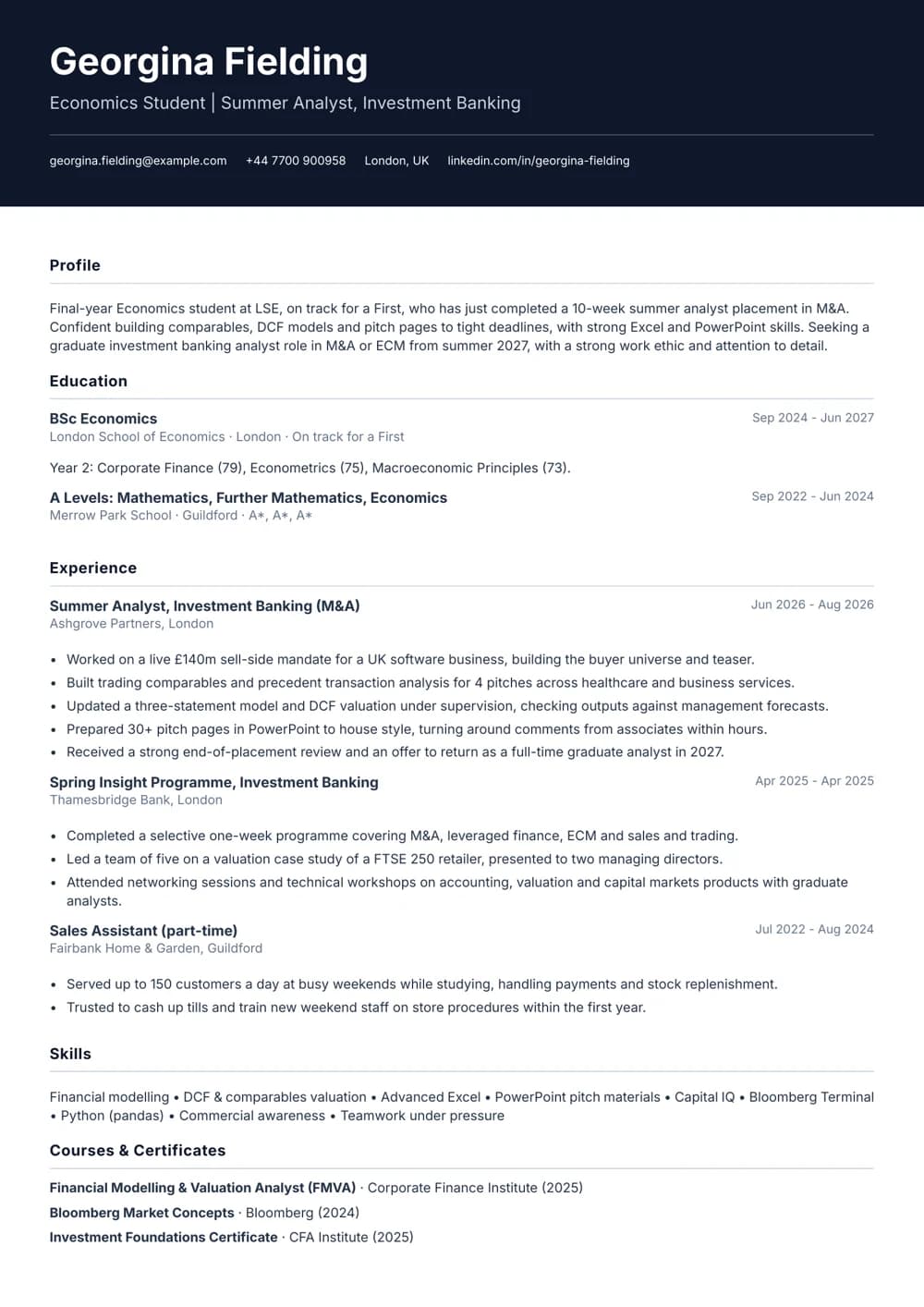
An investment banking CV is read fast and judged hard. Bankers screening applications in the UK look for three things in seconds: strong academics, evidence that you understand deals and valuation, and proof that you can work accurately under pressure. The best investment banking CVs are one page, tightly formatted and full of specifics, such as transactions, deal values, models built and results achieved, rather than generic claims about being driven.
This guide works for spring week and summer analyst applicants, graduate analysts, associates and VPs across M&A, ECM, DCM and leveraged finance. Choose an investment banking CV template above to get a clean, ATS-friendly layout, then use the example, personal statements and tips below to write content that stands up to a UK banker or headhunter reading it closely, line by line, in an interview.
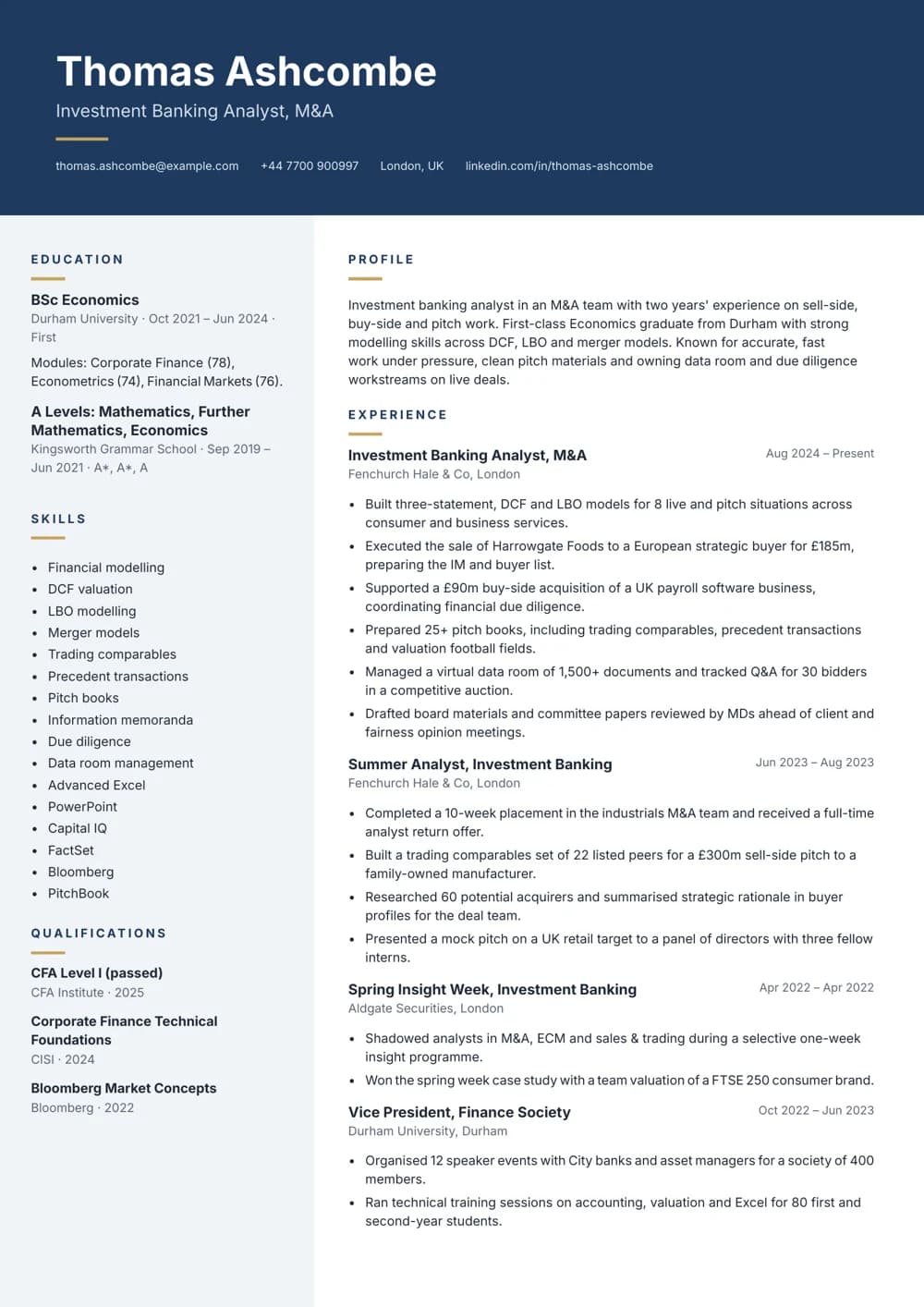
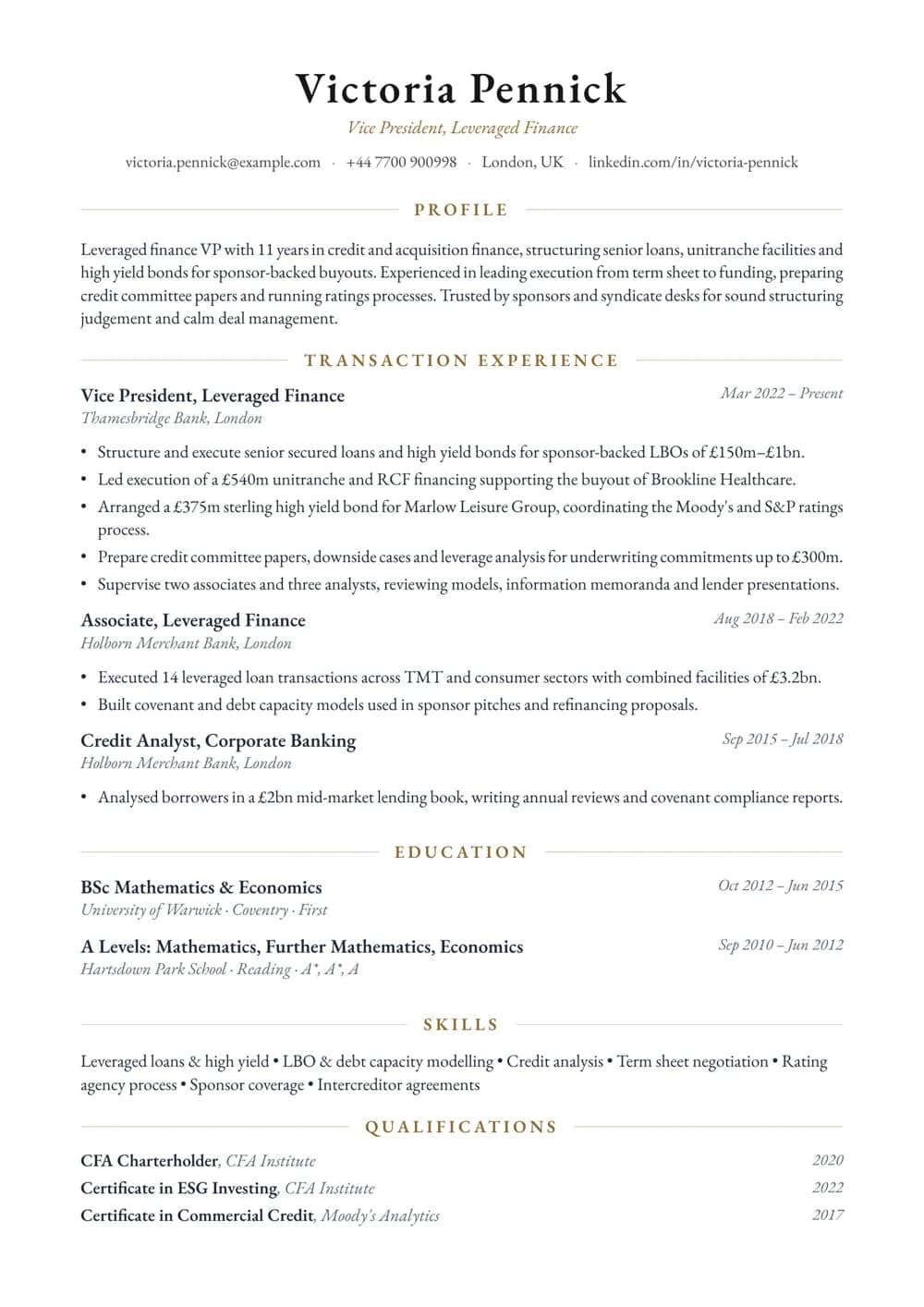
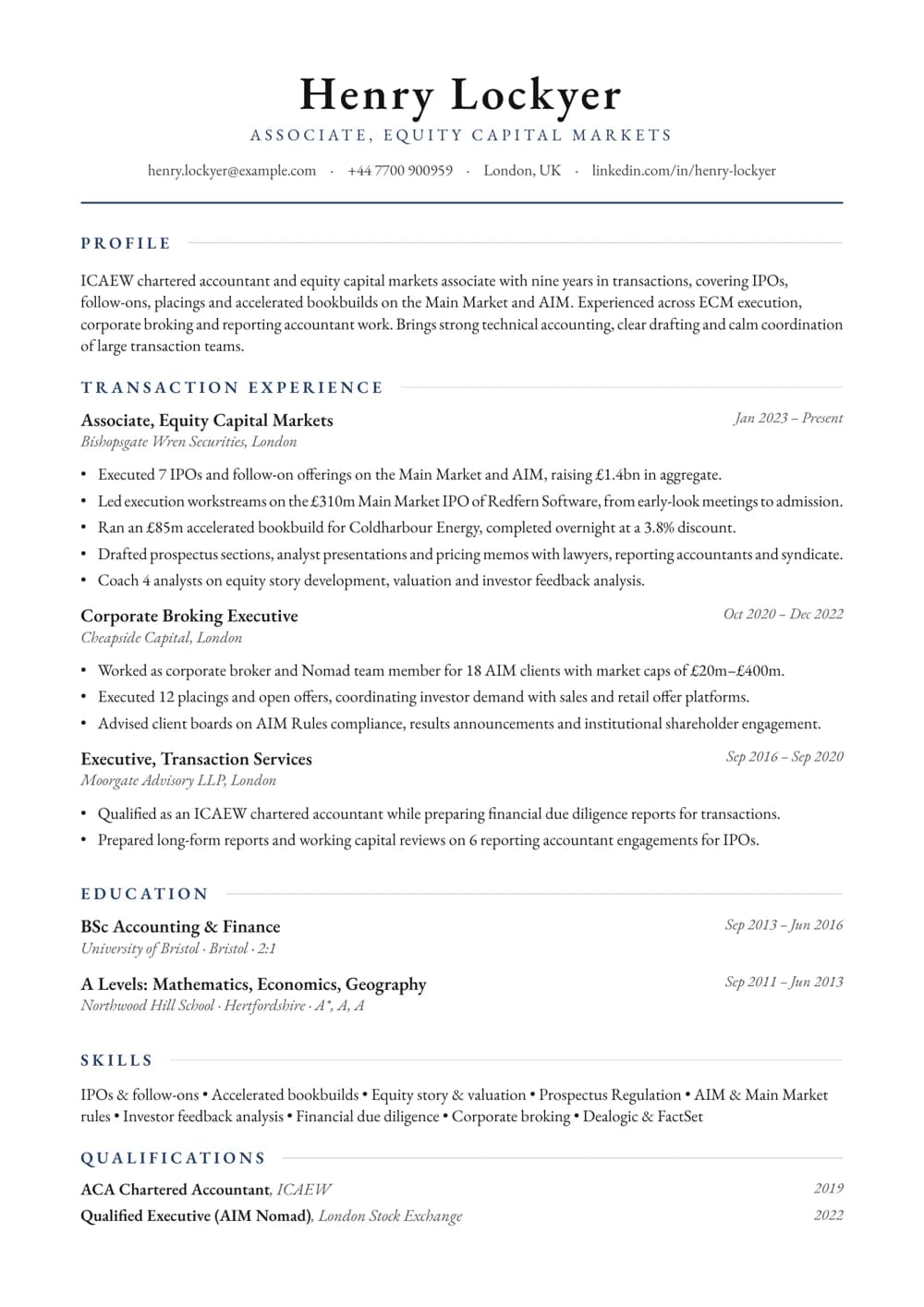
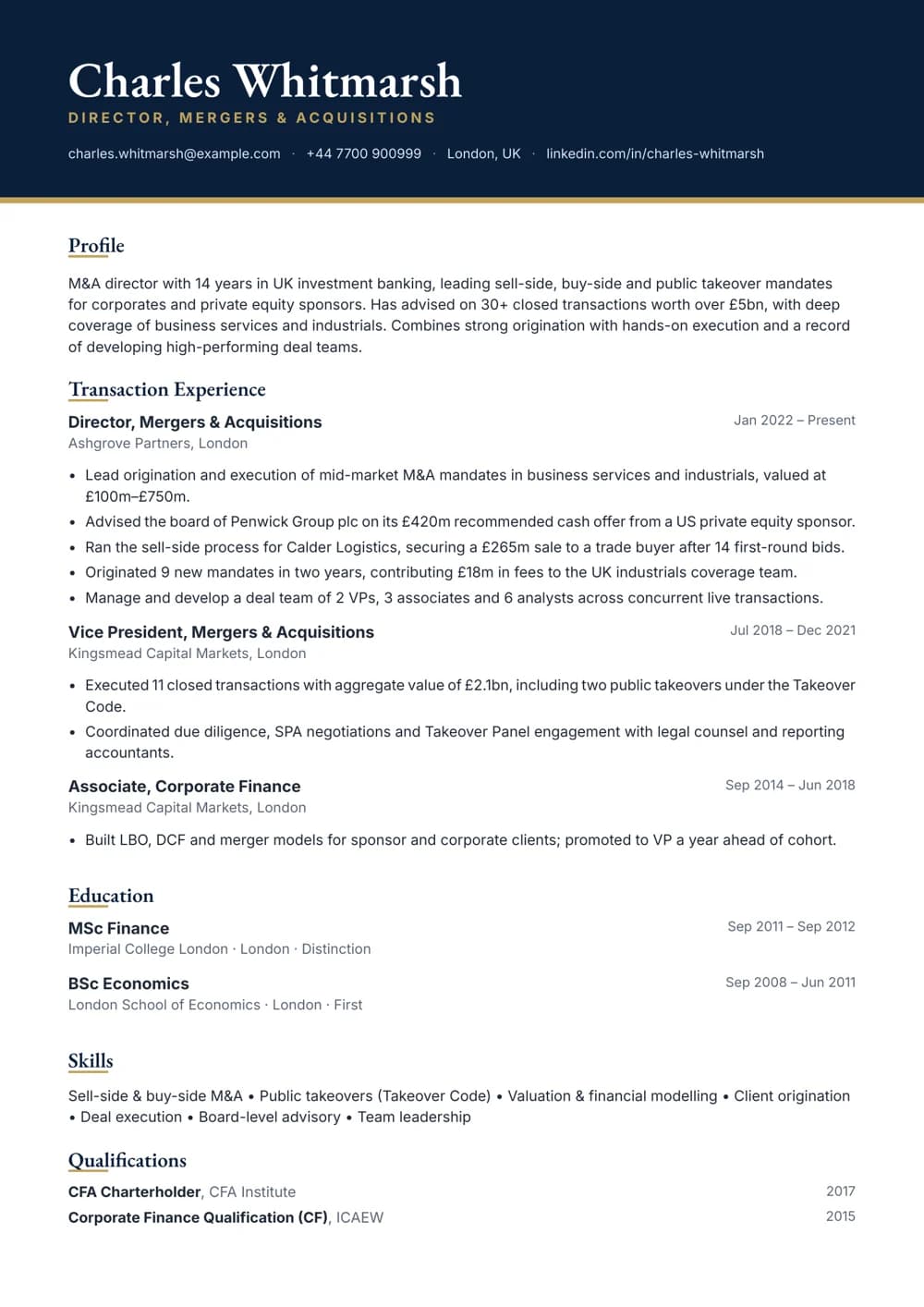
A complete example you can use as a starting point. Pick a template above and the builder will pre-fill similar content for you to edit.
James Whitby
Investment Banking Analyst – Mergers & Acquisitions
London, UK · james.whitby@example.com · 07700 900950
Personal statement
Second-year M&A analyst at a mid-market advisory bank, with experience across sell-side, buy-side and private equity exit mandates in business services and consumer. Builds three-statement, DCF and LBO models, runs data rooms and drafts information memoranda. First-class Economics graduate from the University of Bristol, CFA Level II candidate, known for accurate work and fast turnaround.
Experience
Investment Banking Analyst, M&A, Carrow Street Partners, London
Sep 2024 – Present
- Executed the £210m sale of a private equity-backed facilities services group to a trade buyer, preparing the IM, management presentation and buyer list.
- Built an LBO model to test sponsor returns on a £120m buy-side mandate, supporting the client through two bid rounds.
- Prepared 20+ pitch books covering trading comparables, precedent transactions and valuation summaries.
- Managed a virtual data room of 2,000+ documents and a Q&A log for 25 bidders.
Summer Analyst, Investment Banking, Carrow Street Partners, London
Jun 2023 – Aug 2023
- Supported a consumer M&A team on two live mandates and three pitches over a 10-week placement.
- Researched 50 potential acquirers and wrote buyer profiles used in a £75m sell-side process.
- Received a full-time analyst return offer at the end of the placement.
Education
CFA Level II candidate (Level I passed), CFA Institute
2025 – 2026
BSc Economics, First, University of Bristol
2021 – 2024
A levels: Mathematics A*, Further Mathematics A*, Economics A, Altwood Grammar School
2021
Key skills
Financial modelling (DCF, LBO, merger models) · Trading comps and precedent transactions · Pitch books and IMs · Capital IQ, FactSet, Bloomberg · Advanced Excel and PowerPoint · Due diligence coordination
Education with full grades
For students, analysts and junior associates, education sits at the top. Give your degree, university, classification (or predicted grade) and strong module marks, plus A level grades. Banks still screen on academics, so include scholarships, prizes and top-of-cohort results if you have them. Senior bankers can move education to the bottom.
Deal experience and tombstones
Describe transactions, not duties. For each deal give the type (sell-side, buy-side, IPO, bond issue, LBO financing), the sector, the size in pounds and your role. If a deal is not public, describe it anonymously, e.g. "£150m sale of a UK healthcare services business to a PE sponsor". More senior bankers can add a short list of selected transactions.
Technical and modelling skills
Name the models and analysis you can do: three-statement models, DCF, LBO, merger and accretion/dilution models, trading comparables and precedent transactions. Add the tools banks use, such as Excel, PowerPoint, Capital IQ, FactSet, Bloomberg, Dealogic and PitchBook.
Internships, spring weeks and insight programmes
For students, spring weeks, summer analyst placements and off-cycle internships are the core of the CV. Show what you worked on, what you built and whether you received a return offer. Accounting, Big Four, corporate finance and asset management internships are all relevant too.
Qualifications, leadership and interests
Include CFA progress, ACA or other professional qualifications, and finance or investment society roles. A short line of genuine interests, such as competitive sport, music to a high grade or a demanding volunteering role, often gives interviewers an easy opening question.
Technical skills
- Three-statement financial modelling
- DCF and LBO valuation
- Merger and accretion/dilution analysis
- Trading comparables and precedent transactions
- Credit and debt capacity analysis
- Accounting and financial statement analysis
Tools and data
- Advanced Excel (shortcuts, data tables, VBA)
- PowerPoint and pitch book formatting
- Capital IQ and FactSet
- Bloomberg Terminal
- Dealogic and PitchBook
- Virtual data rooms (e.g. Datasite, Intralinks)
Professional skills
- Attention to detail
- Working under pressure to deadlines
- Commercial awareness
- Clear written communication
- Teamwork on deal teams
- Client and stakeholder management
Student / summer analyst applicant
Second-year Economics student at the University of Warwick, predicted a First, applying for a summer analyst role in M&A. Completed spring weeks at two investment banks and lead the valuation team of the university investment society. Confident building DCF models and comparables in Excel, with strong attention to detail and a genuine interest in UK mid-market deals.
Analyst / associate
Investment banking associate with four years in ECM and M&A, having executed nine IPOs, placings and sell-side processes worth over £2bn in aggregate. Lead day-to-day execution, from modelling and drafting to managing lawyers, accountants and data rooms. ACA qualified, with strong technical accounting and a track record of training and reviewing analysts.
Vice president / director
M&A director with 13 years in UK and European advisory, covering industrials and business services. Lead origination and execution of sell-side, buy-side and public takeover mandates valued at £100m–£1bn, with a strong network among corporates and private equity sponsors. Experienced in building and developing high-performing deal teams.
- Keep it to one page. One page is the convention for analysts and associates in UK banking. Cut weak bullets and old part-time jobs before you shrink the font.
- Put numbers on every deal. Deal value, number of bidders, models built, pitches prepared and fees won all show scale. Use £ values and round figures you can defend in interview.
- Expect to be tested on every line. Interviewers often pick a deal from your CV and ask you to walk through it, including valuation and rationale. Only include work you can explain in detail.
- Use a plain, consistent format. Banks favour clean, conservative CVs with consistent dates, bold job titles and no graphics. Many also use applicant tracking systems, so avoid tables and text boxes.
- Tailor to the division. Lead with the most relevant experience for M&A, ECM, DCM, leveraged finance or restructuring, and mirror the skills and products named in the job description.
How long should an investment banking CV be?+
One A4 page is standard for UK investment banking CVs at student, analyst and associate level. Recruiters and bankers expect a dense, well-edited single page. Senior bankers such as VPs, directors and MDs sometimes use two pages, often with a separate list of selected transactions, but one page is still preferred where possible.
Should I include A level grades on an investment banking CV?+
Yes, especially for spring weeks, summer internships and graduate analyst roles. UK banks commonly look at A level results alongside your degree classification or predicted grade. Include GCSE results only if they are particularly strong or you have little else to show. After a few years in banking, your degree is usually enough.
How do I write an investment banking CV with no experience?+
Lead with education and grades, then add any finance exposure: spring weeks, insight days, virtual internships, investment society roles, trading competitions and stock pitches. Part-time jobs still count when you show responsibility, accuracy and teamwork. A short section on modelling courses, such as CFA Investment Foundations or a financial modelling course, also shows initiative.
Should I put a photo on my investment banking CV?+
No. UK banking CVs should not include a photo, date of birth, nationality or marital status. Firms want to reduce the risk of bias, and a photo uses space that is better spent on deals, grades and skills. You may need to state your right to work in the UK on an application form, but it does not need a section on your CV.
How do I describe confidential deals on my CV?+
Only name a client if the transaction has been publicly announced. For anything else, describe it generically by sector, deal type and approximate size, for example "£200m sale of a UK software business to a trade buyer". Many bankers use generic descriptions for all deals to be safe, and interviewers understand why.
Is a CV or cover letter more important for banking applications?+
The CV matters most. Many UK banks use online application forms with competency questions for internships and graduate programmes, but most still ask for a CV, and it is the main document used for lateral hires and headhunter submissions. Some banks no longer require cover letters, so check each application and keep any letter short and specific.
Browse all our CV templates for every role and industry.
View All Templates