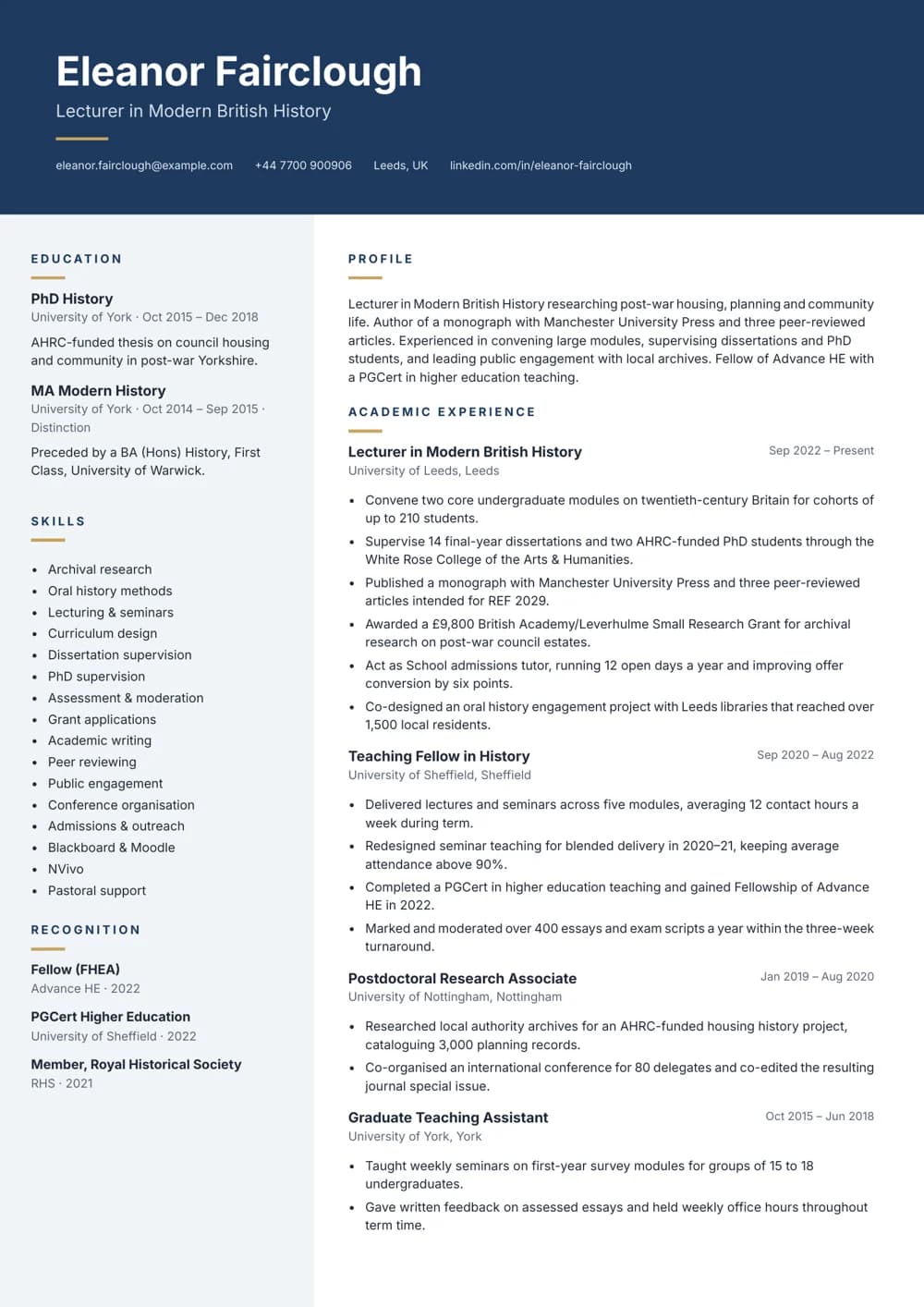
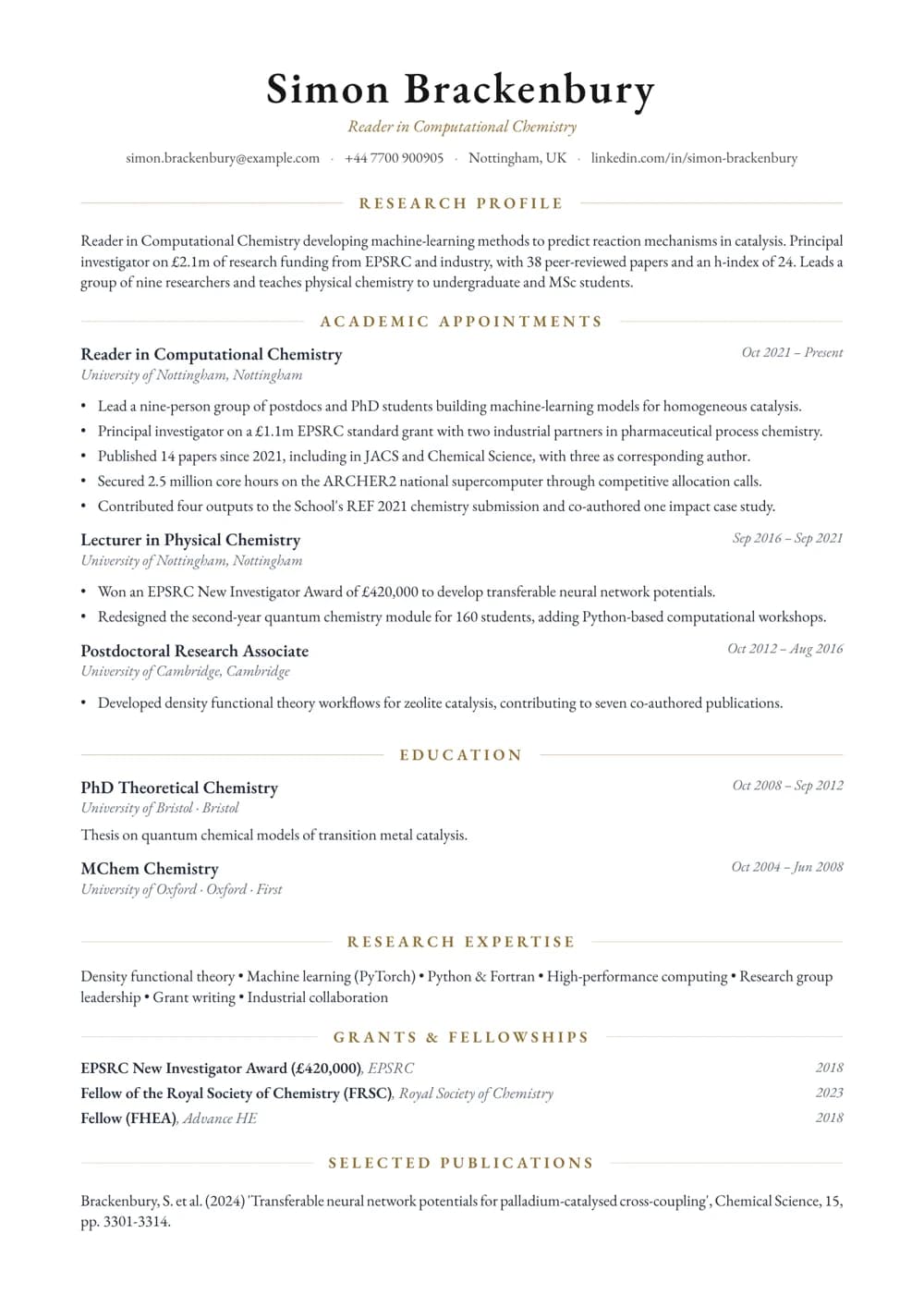
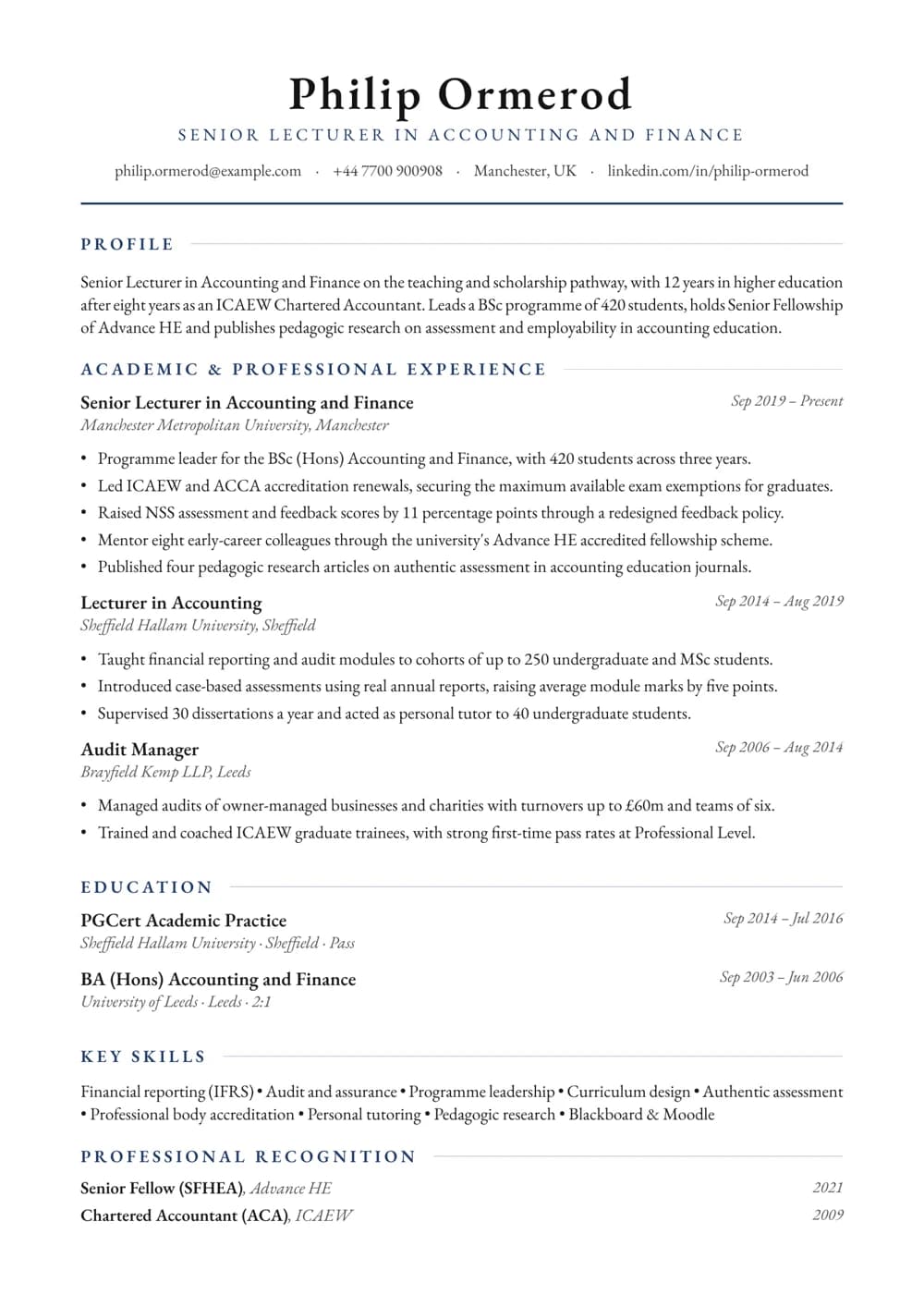
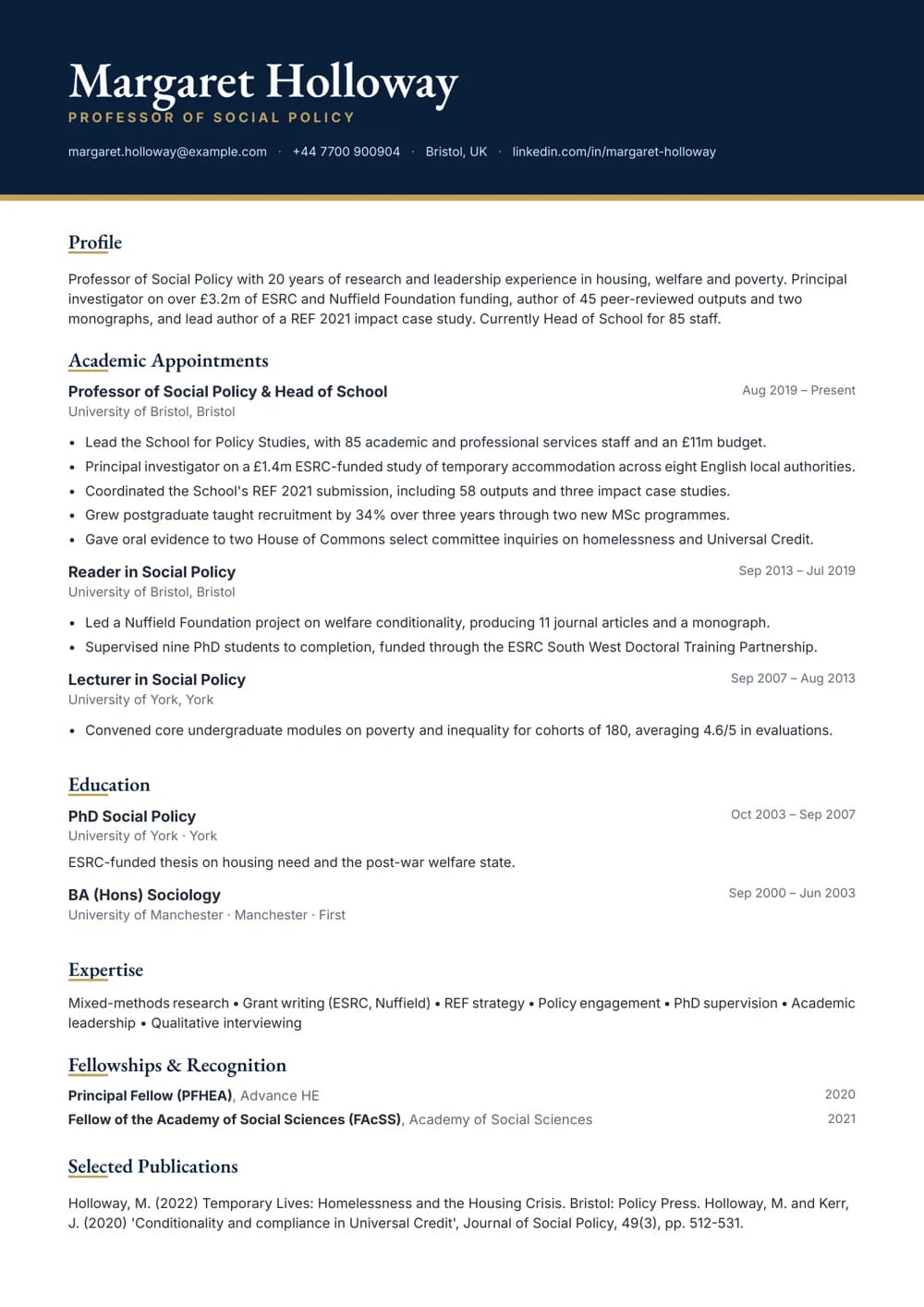
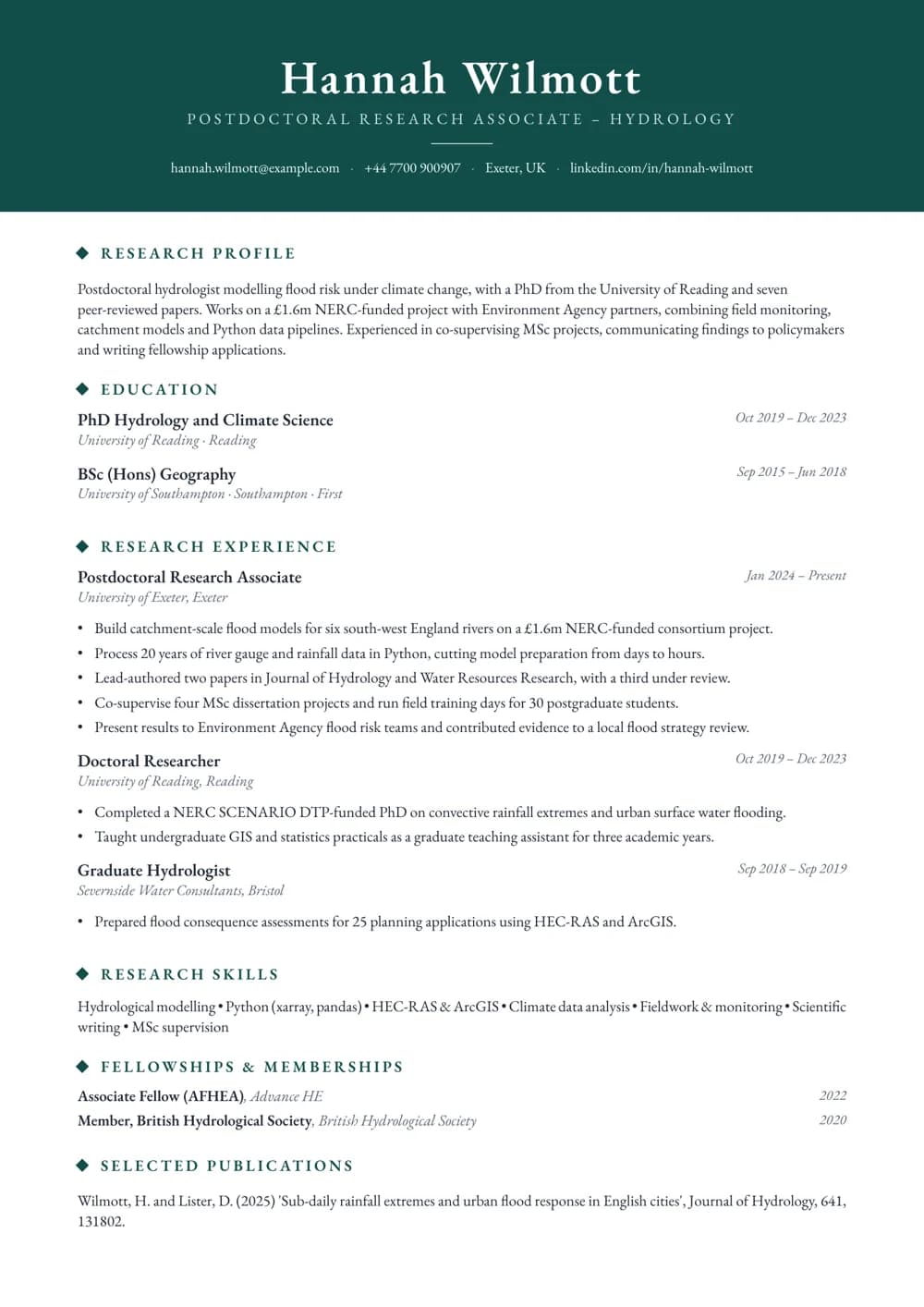
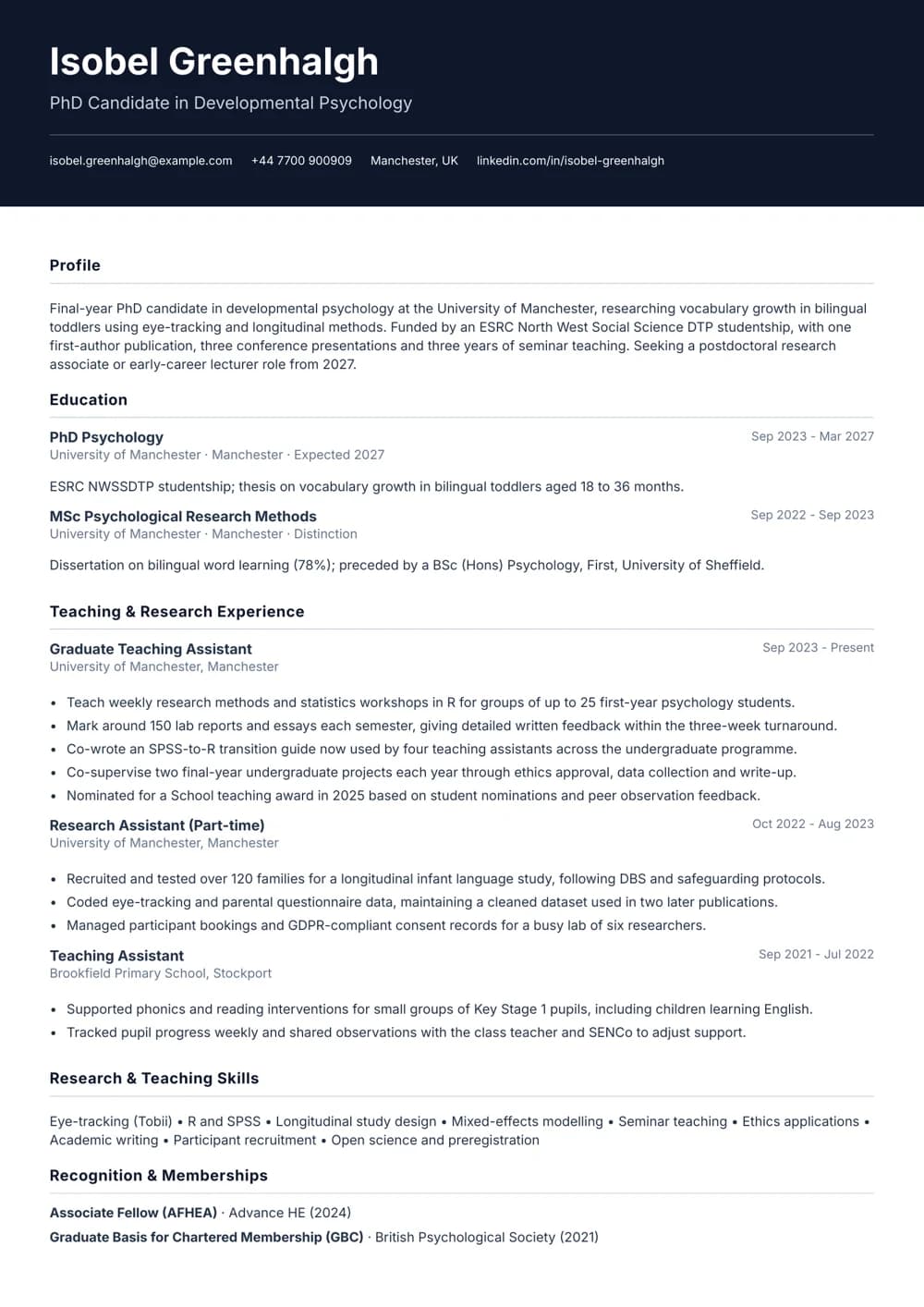
An academic CV is not a business CV with a publications list bolted on. Hiring panels at UK universities read it to judge three things: the quality and direction of your research, your record of winning funding, and your teaching and citizenship. The strongest academic CVs make those three strands easy to find, use precise references for outputs, and show where your work fits the department's REF and teaching priorities.
Whether you are a PhD candidate applying for a first postdoc, a lecturer moving institution or a professor applying for a chair, the structure below works for UK academic posts. Choose one of the academic CV templates above to get a clean, ATS-friendly layout, then use the example, statements and FAQs on this page to write content that stands up to a shortlisting panel.
A complete example you can use as a starting point. Pick a template above and the builder will pre-fill similar content for you to edit.
Personal statement
Lecturer in Criminology researching policing, procedural justice and public trust, with six peer-reviewed articles, a co-edited volume and £310,000 of external funding as principal or co-investigator. Experienced in convening large undergraduate modules, supervising MSc dissertations and working with police forces on evidence-based practice. Fellow of Advance HE (FHEA) with a PGCert in teaching in higher education.
Experience
Lecturer in Criminology, Cardiff University
Sep 2022 – Present
- Convene two core undergraduate modules on policing and criminal justice for cohorts of 180 students, with consistently positive module evaluations.
- Co-investigator on a £260,000 ESRC-funded project on public confidence in neighbourhood policing across three Welsh forces.
- Published three articles in leading criminology journals since 2022 and co-edited a volume on procedural justice.
- Supervise 12 MSc dissertations a year and co-supervise one ESRC-funded doctoral student.
Postdoctoral Research Associate, University of Leeds
Oct 2019 – Aug 2022
- Managed fieldwork for a mixed-methods study of police stop and search, including 60 interviews and a survey of 1,200 residents.
- Won a £50,000 follow-on impact grant to co-produce training materials with a regional police force.
- Taught seminars on research methods and criminological theory to second-year undergraduates.
Education
PhD Criminology, University of Leeds
2015 – 2019
MSc Social Research Methods, Distinction, University of Leeds
2014 – 2015
BA (Hons) Sociology and Criminology, First, University of Liverpool
2011 – 2014
Key skills
Mixed-methods research · NVivo and Stata · Grant writing (ESRC, UKRI) · Module convening · Dissertation supervision · Stakeholder and policy engagement
Research profile and current post
Open with a short profile stating your field, current post (or PhD stage), your main research questions and the strongest evidence of quality: key outputs, funding and impact. Include your ORCID iD alongside contact details so panels can check your record quickly.
Publications and outputs
List peer-reviewed articles, books, chapters and other outputs in a consistent referencing style, most recent first. Bold your own name, mark outputs under review or in press clearly, and separate peer-reviewed work from reports, blogs and media. Early-career applicants can include conference papers here.
Grants, funding and awards
Give each award with the funder (e.g. ESRC, EPSRC, AHRC, NERC, Leverhulme, British Academy, Wellcome), your role (PI, Co-I, researcher), the amount and the dates. UKRI and charity funding is a major shortlisting factor, so make this section easy to find, and include smaller internal and travel grants if you are early in your career.
Teaching and supervision
Name the modules you have convened or taught, the level and cohort size, and your role in design and assessment. Add doctoral and masters supervision, PGCert HE and Advance HE Fellowship (AFHEA, FHEA, SFHEA or PFHEA). Teaching-focused posts will expect evidence of innovation, student outcomes and scholarship of teaching.
Impact, engagement and citizenship
Show how your research reaches beyond academia (policy evidence, industry partnerships, public engagement, REF impact case studies) and what you contribute to the department: committee roles, admissions, peer review, editorial boards and conference organisation.
Research skills
- Research design and methodology
- Quantitative or qualitative analysis
- Academic writing and peer review
- Grant and fellowship writing
- Research ethics and data management
- Interdisciplinary collaboration
Teaching and supervision
- Lecturing and seminar teaching
- Module and curriculum design
- Assessment, marking and moderation
- Dissertation and PhD supervision
- VLEs such as Moodle, Blackboard or Canvas
- Inclusive and blended teaching
Leadership and engagement
- Project and budget management
- Policy and industry engagement
- Public engagement and media work
- Committee and admissions work
- Mentoring early-career researchers
PhD candidate / early-career researcher
Final-year PhD candidate in human geography at the University of Sheffield, researching community energy and the net zero transition. I have one first-author article published and another under review, have presented at the RGS-IBG annual conference, and have taught seminars on two undergraduate modules. I am looking for a postdoctoral research associate role on a funded energy or climate project.
Lecturer
Lecturer in Marketing with five years of post-PhD experience researching consumer behaviour and sustainability. I have published seven peer-reviewed articles, hold a British Academy/Leverhulme Small Research Grant and convene a final-year module of 250 students. I am an FHEA and have supervised more than 60 masters dissertations.
Senior academic / professor
Professor of Electrical Engineering and Director of a 40-person research centre, with over £8m of EPSRC and industry funding as principal investigator and 120 peer-reviewed publications. I have led a unit of assessment for REF 2021, supervised 25 PhD students to completion and hold strategic partnerships with three UK energy companies.
- Read the person specification line by line. UK academic shortlisting is done against the essential and desirable criteria. Make sure every essential criterion is clearly evidenced in your CV or covering letter, using the same wording where you can.
- Put your strongest section first. A research-intensive post should see publications and grants near the top. For a teaching and scholarship post, lead with teaching experience, Advance HE Fellowship and pedagogic outputs.
- Give numbers for funding and teaching. Grant values, your role on each award, module cohort sizes, numbers of supervisees and completions all help a panel judge your level quickly.
- Use a consistent referencing style. Choose one style for all outputs, bold your name, and include DOIs or links where useful. Inconsistent references look careless to a panel of academics.
- Keep the core CV focused. Put your most relevant outputs and activities in the main CV and move long lists of talks, reviewing or minor outputs into a clearly labelled appendix if the application allows it.
How long should an academic CV be in the UK?+
There is no fixed rule. PhD candidates and postdocs usually need two to three pages, while lecturers and professors often run to four pages or more because of publications, grants and supervision. Check the job pack first: some universities set a page limit or ask for a two-page CV plus a full publication list.
Should I include a photo on an academic CV?+
No. UK universities do not expect a photo, and leaving out your photo, date of birth and marital status helps avoid bias in shortlisting. Use the space for outputs, funding and teaching instead. A professional photo on your staff profile or LinkedIn page is fine.
How do I write an academic CV as a PhD student?+
Lead with education, giving your thesis title, supervisors, funder and expected submission date. Then add publications and conference papers, teaching (seminars, marking, demonstrating), research assistant work, awards and training. Even small items such as travel grants, departmental prizes and organising a reading group show momentum.
Should publications go in the main CV or an appendix?+
Early-career researchers should list all publications in the main CV. Once your list is long, include selected or most relevant outputs in the main CV and put the full list in an appendix, unless the job pack asks for something different. Always flag outputs that are in press or under review.
Do I need to mention the REF on my academic CV?+
You do not need to use REF ratings, which are not published for individual outputs. It is useful to show outputs you expect to be returned, roles in a REF submission, and any impact case study you contributed to, because departments plan hiring around their next REF return.
What is the difference between an academic CV and a supporting statement?+
The CV is a factual record of your posts, outputs, funding, teaching and service. The supporting statement or covering letter explains how that record meets each criterion in the person specification and what you would bring to the department. Most UK academic applications need both, so keep the CV concise and evidence-led.
Browse all our CV templates for every role and industry.
View All Templates