Teacher CV Examples
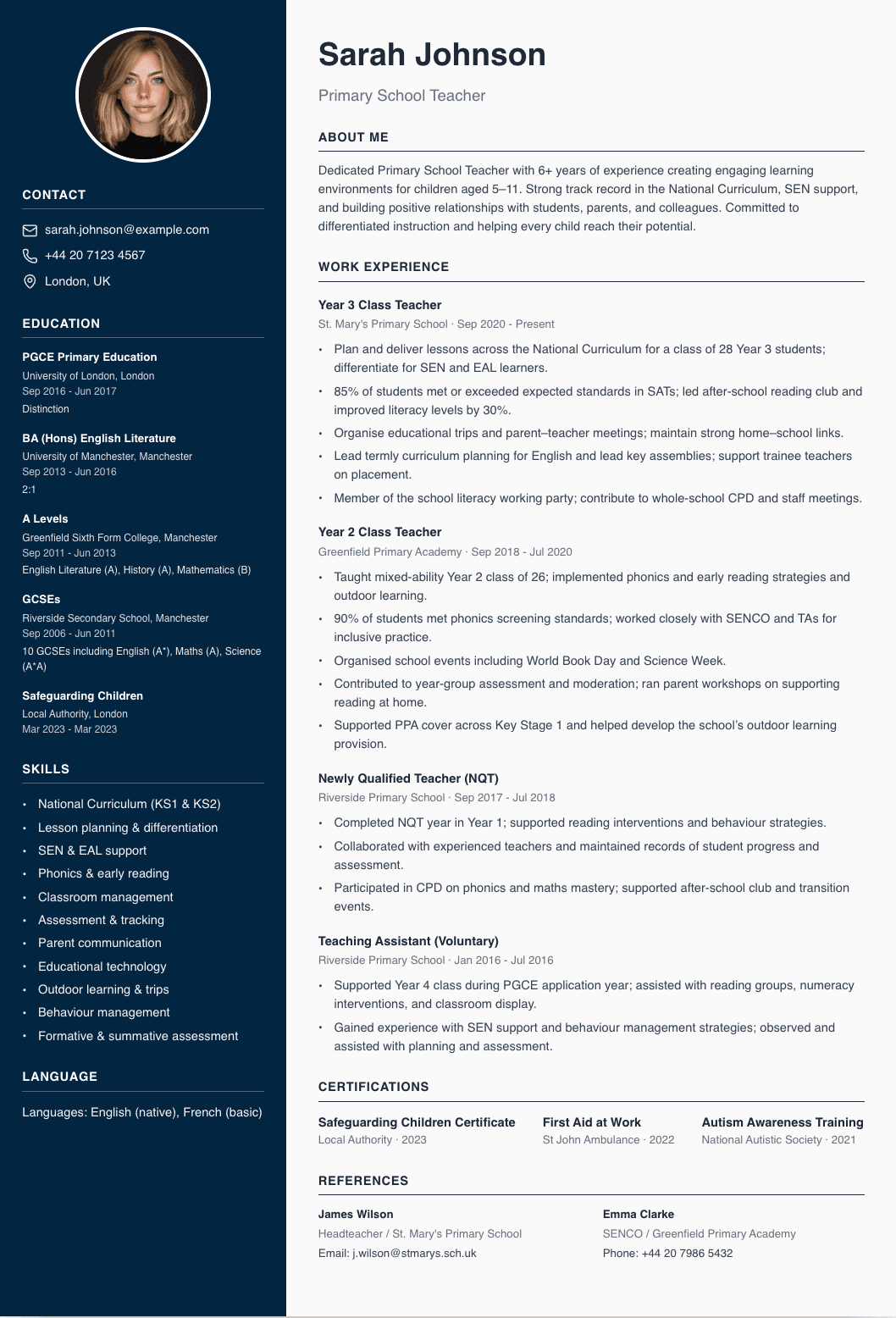
Take a look at the 8 examples below before we break down the key sections of a teacher's CV and how to structure one.
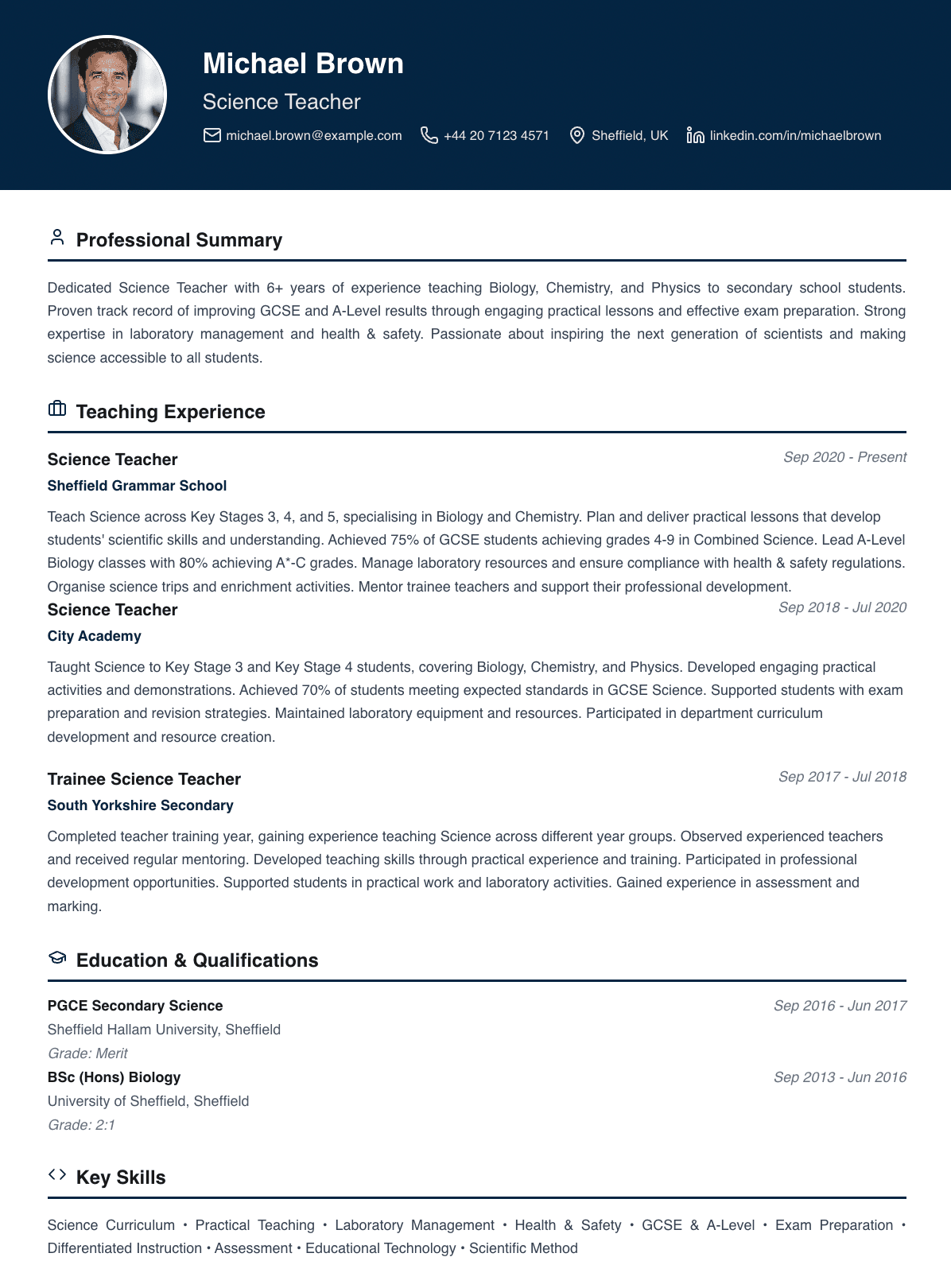
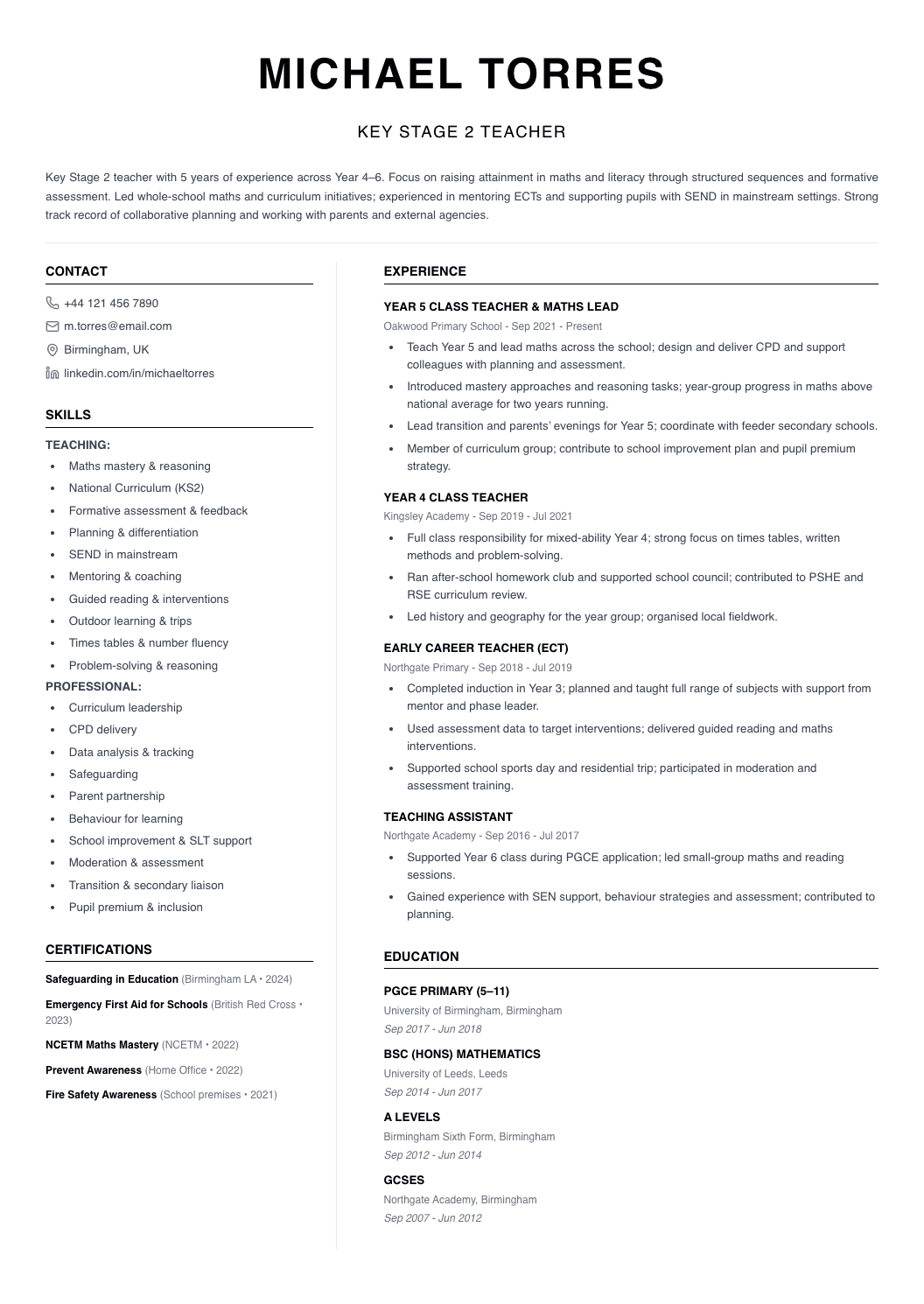
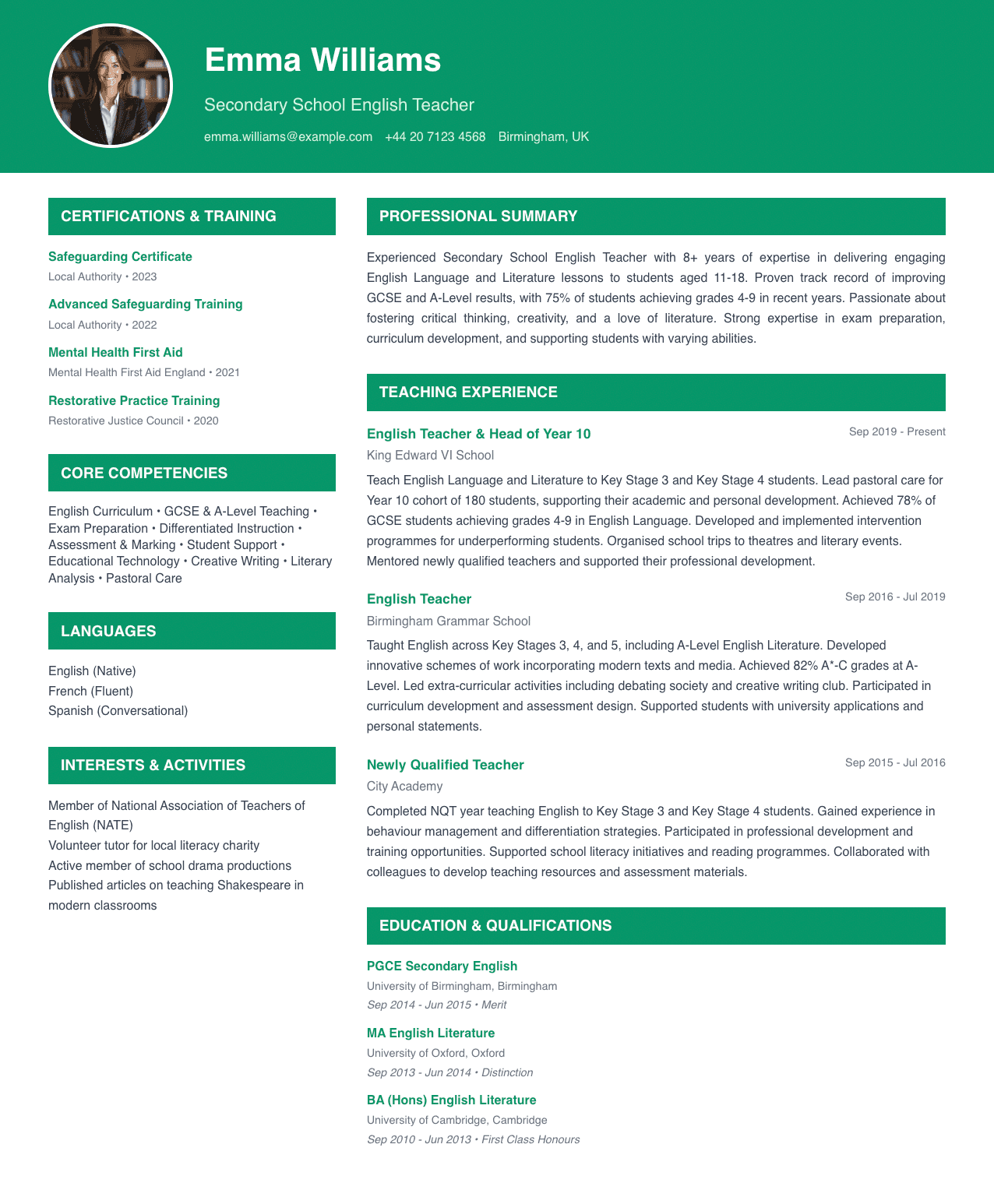
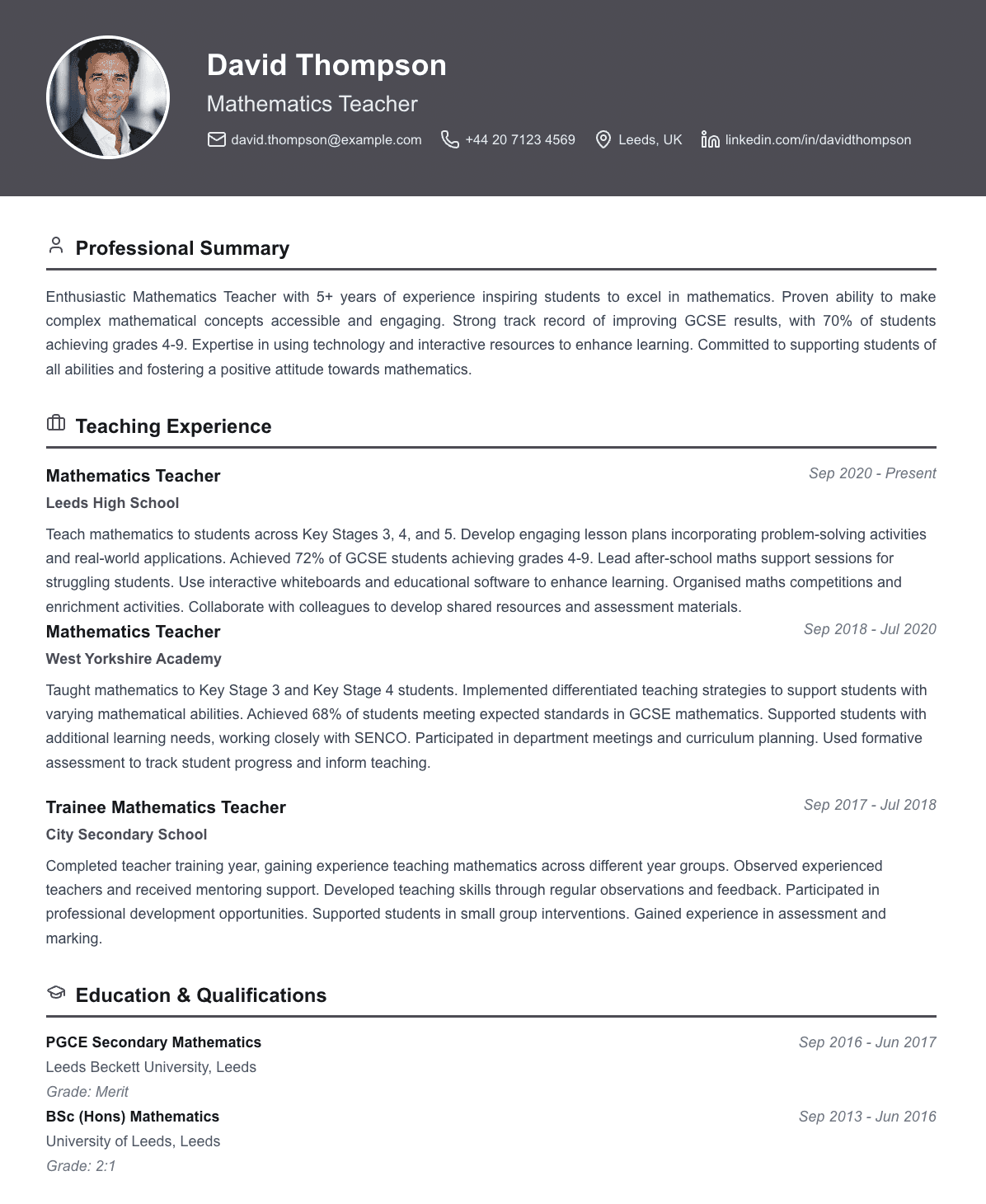
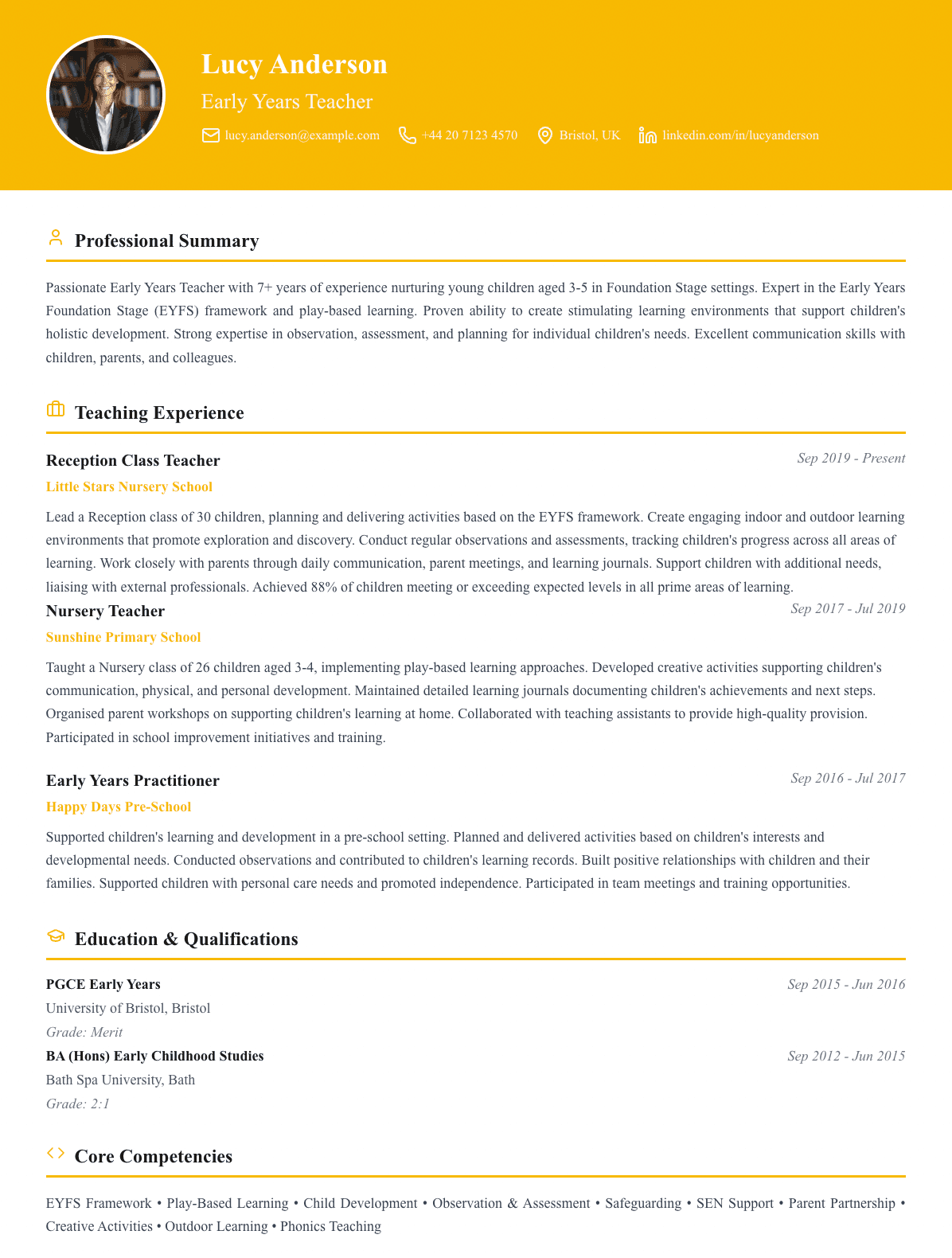
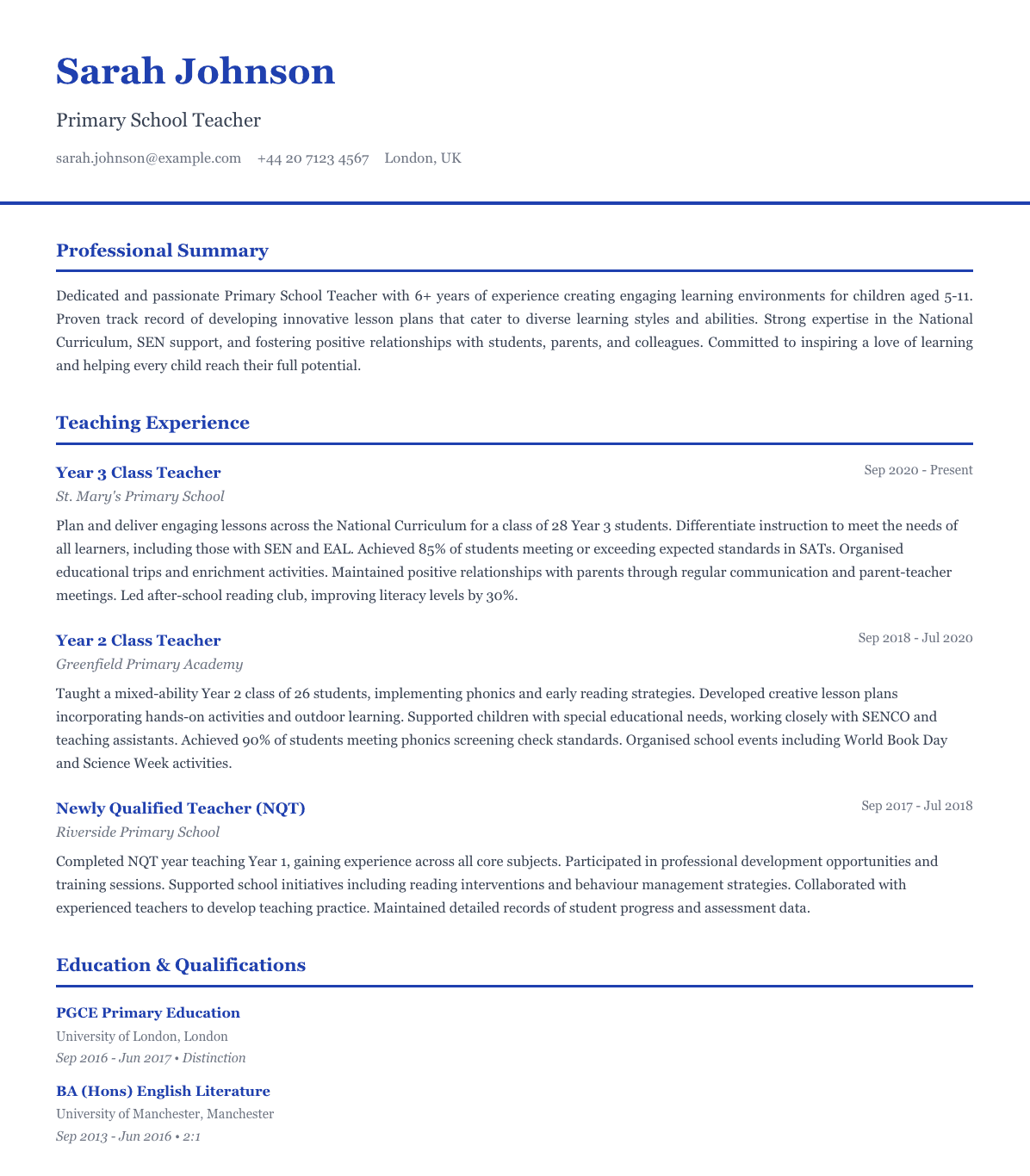
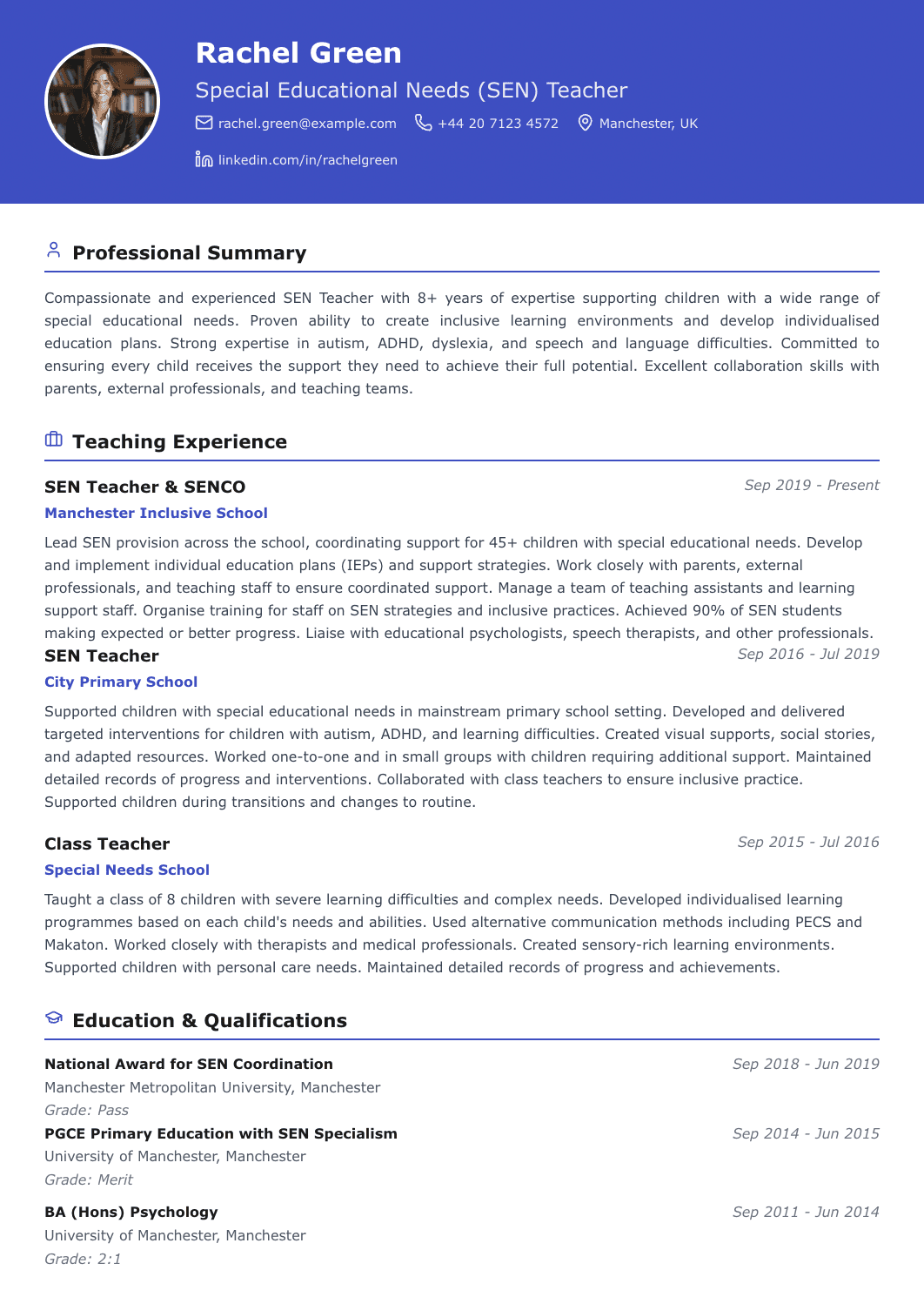
How to Structure a Teacher CV
Whether you work in primary, secondary, or specialist education, your CV should clearly show your ability to combine subject knowledge, creativity, and strong classroom control. Structuring your CV correctly helps schools quickly understand that you have the skills and experience required for the role.
A well-structured teacher CV makes it easy for headteachers and hiring panels to find the information they need. Follow these tips to keep your CV clear and professional:
- Organise your CV into clearly labelled sections
- Outside of the professional summary, use bullet points to keep information concise
- Avoid bright colours or overly decorative designs
- Choose a clean, easy-to-read font (e.g. Arial, Calibri)
- Keep it short and sweet by capping your CV at a maximum of two pages
Contact Details
Your contact details go at the top of your CV so that employers have a way to contact you. Include your full name, mobile number and email address. Your email address should sound professional, something like firstname.surname@email.com - make a new one if you need to. This section can optionally include your location (town or city) and a link to your LinkedIn profile. Avoid unnecessary details such as date of birth or full home address.
What to include
- Full name and professional title (e.g. Science Teacher)
- Professional email address
- Mobile phone number
- Town or city (optional)
- LinkedIn profile (optional)
What to leave out
- Full home address
- Date of birth
- Marital status
- Photograph (unless specifically requested)
Professional Summary
Your professional summary should cover your years of experience, subjects and specialisms, and skills and outcomes. We have highlighted each of these in the examples below. It also provides an opportunity to show enthusiasm for the role but keep it concise - 2-4 sentences is perfect for your summary.
Dedicated and results-driven primary school teacher with over 8 years of experience teaching across KS1 and KS2. Currently serving as English subject lead, with a proven track record of raising attainment in reading and writing through targeted intervention programmes and effective differentiation.
Enthusiastic secondary school teacher with 5 years of experience delivering engaging History lessons at GCSE and A-Level. Skilled in creating inclusive learning environments and using data-driven assessment strategies to support student progress, consistently achieving above-average exam results.
Newly qualified teacher with QTS and recent placement experience across KS1 and KS2 in both urban and rural settings. Passionate about creative lesson planning, positive behaviour management, and building strong relationships with pupils, parents and colleagues.
It is worth tailoring this section to each job you are applying for. Job descriptions will often highlight key skills that the school is looking for and it is worth mentioning them (if you have them) in your summary - for example, if a job description mentions phonics, SEND provision, or curriculum leadership, make sure you highlight experience in those areas.
Skills
The skills section allows you to demonstrate the teaching skills you have learned over the years. Most schools will expect classroom management, lesson planning, and catering to students of different learning abilities, but you can set yourself apart with skills like curriculum planning, data analysis and technology integration.
Here are some of the top skills to include for teaching jobs:
Read through the job description carefully to ensure you include the skills they are looking for (that you possess). QTS status and holding a valid enhanced DBS check are standard requirements for most teaching roles. Additional qualifications including SENCO awards, NPQML or specialist subject skills are worth mentioning as well.
Professional Experience
Your professional experience should be listed in reverse chronological order, with your most recent role at the top. For each position, include the school name, your role title, and the dates you worked there. Use bullet points to describe your responsibilities and achievements.
Focus on outcomes rather than just listing duties. Schools want to see the impact you have had on pupil progress and school improvement. Quantify your achievements wherever possible with data and percentages.
Led the Year 6 SATs preparation programme, achieving 85% of pupils meeting the expected standard in reading - 12 percentage points above the national average.
Responsible for teaching Year 6 and preparing students for SATs.
The strong example demonstrates measurable impact with specific data, while the weak example simply describes a duty without showing any results. Use strong action verbs like led, developed, implemented, improved, and coordinated. Avoid vague phrases like "responsible for" or "helped with".
For each role, aim to include 3-5 bullet points that highlight your most impressive contributions. Think about what you achieved beyond the basic requirements of the job - did you introduce a new reading scheme, lead a year group, or mentor trainee teachers?
Education & Qualifications
Teaching is one of the few professions where your qualifications are non-negotiable. Schools need to see your QTS status, your teaching degree or PGCE, and your undergraduate subject at a glance. List your qualifications in reverse chronological order, starting with the most recent.
For each qualification, include the title, the institution, the dates, and the grade or classification. If you are currently studying, write the expected completion date.
PGCE Primary Education
University of Bristol, Sep 2018 - Jun 2019
Grade: Distinction
BA (Hons) English Literature
University of Leeds, Sep 2015 - Jun 2018
Grade: 2:1
A-Levels
Woodhouse College, Sep 2013 - Jun 2015
English Literature (A), History (B), Psychology (B)
What to include at different career stages
NQTs / ECTs
List everything - PGCE or BEd with grade, undergraduate degree with classification, A-Levels with grades. Mention any specialist modules, dissertation topics, or school-based training placements that are relevant to the role you are applying for.
Experienced teachers (5+ years)
Keep it concise. PGCE/BEd, undergraduate degree, and any additional qualifications (SENCO, NPQML, NPQSL) are enough. You can drop A-Level details once you have several years of classroom experience - your track record speaks louder than your grades.
Career changers
Lead with your teaching qualification (PGCE, School Direct, Teach First) and then list your original degree. If your degree subject is relevant to the role (e.g. a Maths degree for a secondary Maths position), make sure that is clear. Mention any Subject Knowledge Enhancement (SKE) courses you have completed.
Projects
For teachers, the projects section covers contributions that go beyond your day-to-day classroom teaching. This is your chance to show that you are invested in the wider school community and committed to professional development. Projects might include:
Extracurricular clubs or activities you have run (e.g. drama club, sports teams, coding club)
Curriculum development or resource creation for your department or year group
School improvement initiatives you have contributed to (e.g. behaviour policies, reading programmes)
CPD programmes you have led or participated in
Trips, residentials or events you have organised
When writing about projects, follow the same approach as your professional experience. Be specific about what you did and the outcome. For example, rather than writing "Ran an after-school club", write "Established and led a weekly creative writing club for Year 5, growing attendance from 8 to 24 pupils over one term."
Additional Information
This is an optional section where you can include anything that strengthens your application but does not fit neatly into the sections above. Use it sparingly - only include information that is genuinely relevant to a teaching role.
What works well here
- Languages spoken (valuable in schools with diverse intakes)
- Coaching qualifications or sports experience (e.g. FA Level 1, netball, swimming)
- Duke of Edinburgh leader or coordinator experience
- Music grades or drama training (useful for primary and performing arts roles)
- First aid certification (paediatric first aid is a plus for primary and EYFS)
- Volunteering with young people (Scouts, Guides, youth clubs)
What to leave out
Avoid listing generic hobbies like reading, cooking, or going to the gym. These do not tell a hiring panel anything useful. If a hobby does not relate to working with young people, contributing to school life, or developing a skill relevant to teaching, leave it off. The space is better used elsewhere.
Also avoid listing your driving licence unless the role specifically requires travel between sites (e.g. peripatetic music teachers or multi-academy trust roles).
References
Teaching roles typically require two references, and one of these should be from your current or most recent headteacher. Schools will usually contact your referees before interview, so it is important to let them know they may be contacted and to keep their details up to date.
You can write "References available on request" on your CV, but be aware that schools will ask for them early in the process - often before the interview stage. Having your references ready to go can speed things up and show that you are well-prepared.
What to include for each referee
- - Full name and professional title (e.g. Mrs J. Smith, Headteacher)
- - School name
- - Email address and/or phone number
- - Your relationship to the referee (e.g. current headteacher, previous head of department)
Always ask permission before listing someone as a referee. Ensure they are happy to provide a positive reference and that their contact details are correct.
Ready to land your next teaching role?
Create a professional teacher CV that stands out to headteachers and school hiring panels.
Browse Teacher CV Templates